From Reactivity to Clarity: Organizational Observability Systems for Engineering Leaders
You’ve built observability systems for your software. You know the difference between monitoring (getting alerted when something breaks) and observability (being able to ask new questions about why your system behaves the way it does). You’d never run a complex distributed system without instrumentation.
But out of the pressure that comes from being in highly compressed roles and a multitude of priorities to juggle (and a lack of a good system – we’re here to change that!), many engineering leaders are running their organizations on spidey senses, hope, and whatever their managers happen to tell them.
This article introduces you to the OO11y framework, a system to create organizational observability for engineering leaders. It helps you build the systems that let you actually see what’s going on in your org, instead of hoping you’ll catch it. In its companion article “Building Your Organizational Observability (OO11y) System: Exercises, Templates, and Your First 30 Days”, you’ll find a self-guided worksheet to tackle the visibility issues in your org.
Article summary
If you only have two minutes:
Most leaders are monitoring their orgs (reacting when something breaks) rather than observing them (having systems that let you understand what’s going on and why). That’s a problem, and it’s getting worse.
*Organizational observability rests on three pillars: Signals (what you measure), Conversations & Chats (what you hear), and Judgment (what you trust). You need all three. They’re joined through sense-making, the practice of cross-referencing your three pillars and paying attention to where they don’t line up. That’s where the real insight happens.
OO11y needs to be a system, not a function of your personal heroic effort. Distribute observability across your leadership team.
Start with one gap, not a complete overhaul. Resist the desire to know more of everything, now. Instead, begin with the most pressing areas and build out your OO11y from there. Put a 15-minute weekly review on your calendar to practice OO11y and tweak your system over time.
For the practical exercises and a weekly review template, as well as a complete worksheet to download, see the companion article: Building Your OO11y System.
The Reactivity Trap
This pattern may sound familiar: you’re constantly firefighting, chasing information, reacting to whatever lands in your inbox or Slack next. You’re constantly feeling like you’re behind — not because you’re doing a bad job, but because the information you need to lead well isn’t coming to you. You’re going hunting for it, or worse, you’re not getting it at all.
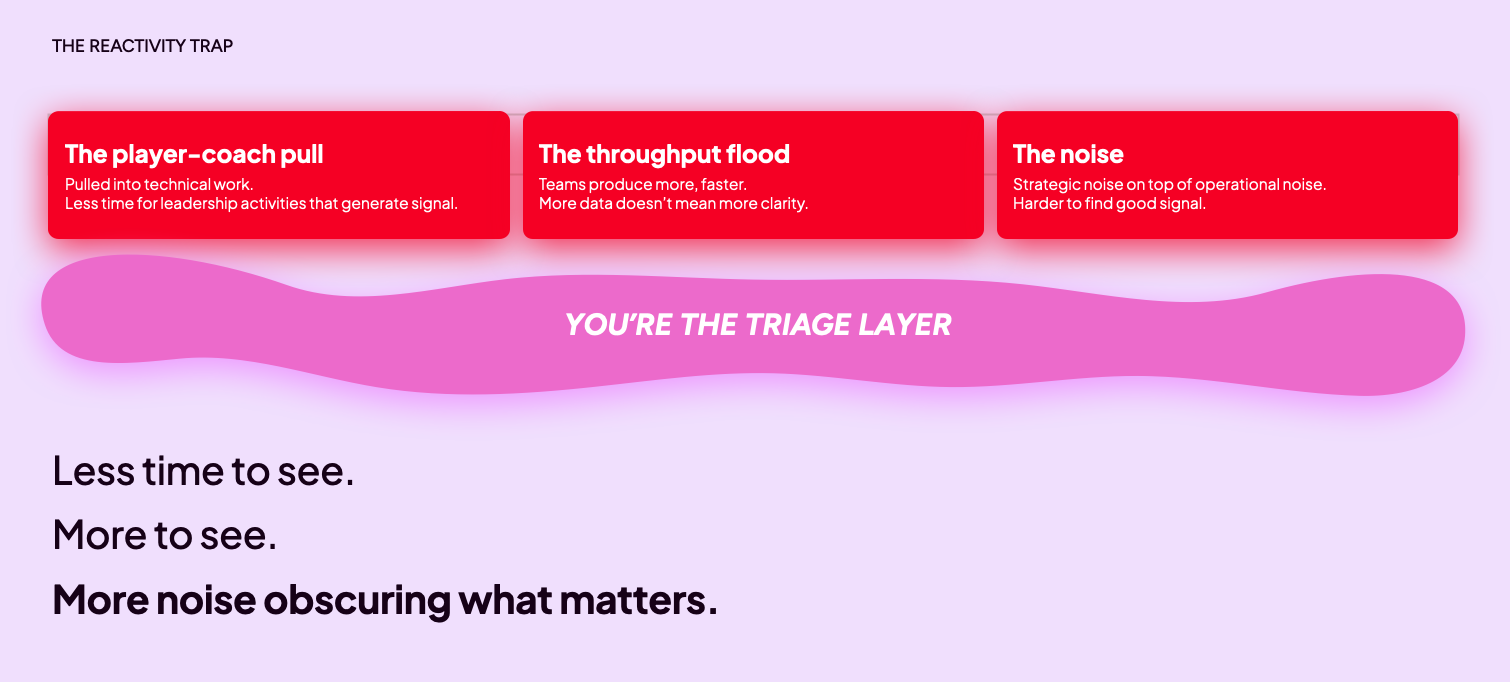
You have less time to see, more things to see, and more noise obscuring what matters.
This isn’t a personal failing. To a degree, that’s always been the nature of roles like ours: not enough time to think, be strategic, and constantly getting pulled into operational work. I would even argue that for many middle management roles, that’s by design, the idea being that it creates a forcing function: You’re the person who has to triage, weigh + balance between the layers above and below you.
Now the problem is that everything you’ve always dealt with has gotten amped up further - and inhabiting that triage function has become much more difficult because of it.
Why this is more urgent now than ever
Three forces in particular that I’m seeing in many organizations this year are making organizational visibility harder and more urgent at the same time.
The player-coach pull. AI is making it easier for managers and directors to contribute technically, and many organizations are actively pushing for that. The result: the leadership activities that generate organizational signal, like 1:1s, skip-level meetings, thinking time, sense-making, are the first things that get compressed. The capacity for seeing is shrinking precisely when there’s more to see.
The throughput flood. AI-augmented teams produce more, faster. More PRs, more docs, more proposals, more Slack messages. Throughput metrics go up, but so does the volume of work product that leaders need to make sense of. More data doesn’t mean more clarity. Often it means less.
The noise. On top of operational noise, leaders are navigating more strategic noise than they’ve had to deal with in a long time: AI hype, board pressure to show AI ROI, shifting expectations about what engineering teams should deliver and how. Separating signal from noise now needs to happen very deliberately at every altitude. from the team to the exec level. (But as we all know, it doesn’t exactly always work that way.)
The upshot: you can’t just “do more 1:1s” or “check in more often.” You need a system.
From Organizational Monitoring to Organizational Observability (OO11y)
The idea behind organizational observability is a translation of the concepts you already know from your technical systems:
Monitoring tells you something broke, so you can react to it. Observability lets you ask new questions about why your system behaves the way it does. Most leaders are monitoring their organizations: Reacting when something breaks, chasing updates, getting surprised by problems that someone should have flagged weeks ago. The shift from monitoring to observability for your org is the shift from reactivity to clarity.
And it’s not just about knowing how things are going right now. It’s also about detecting when something new is emerging before it becomes a crisis or surprise. This could be things like a shifting priority, a strategic shift, a brewing team problem, a dependency forming, a risk nobody’s named yet, and the many other things that can be handled with ease when you know about them early, but tend to blow up your calendar the later it gets.
The difference between leaders who are constantly blindsided and leaders who seem to always know what’s coming isn’t intuition, it’s instrumentation.
Organizational observability is the ability to understand the internal state of your organization — how it’s doing, where it’s heading, whether people have a handle on things — based on the systems you’ve designed to surface that information. It means you don’t chase information all the time, you don’t micromanage, and you don’t have to rely on your own (and your teams’) heroic efforts. You build instrumentation that gives you what you need and helps you spot gaps sooner.
Foundation: What Do You Need to See?
Before you instrument, decide what you’re instrumenting for.
The foundational question is: What do you need to know about your org to lead it well, and what can you not see right now?
Resist the temptation to try and optimize for getting better visibility into everything, immediately. Instead, focus on starting to get better, somewhere. The purpose of choosing is not to ignore the rest — it’s to focus your observability investment where it matters most right now. These priorities will shift as your org, your context, and your challenges change. That’s the nature of your job anyway, so you’ll build a system with that flexibility baked in from the start.
Focus is one of the hardest parts of your job because everything about your role is designed to pull you into all directions, at all times. The whole point of OO11y is to build a way to counter that, while keeping you flexible.
Most engineering leaders in most organizations care about some version of the following areas. Not all will be equally urgent for you right now. Pick 1–2 that feel most pressing:
Speed & delivery — Velocity, iterations and experimentation, timely goal achievement
Engineering excellence — Systems health, tech debt and tradeoffs, developer experience, AI adoption
Team capacity, setup, and sustainability — Workload, well-being, staffing, functioning org and team structures
Decision-making & risk — The right decisions are being made at the right level, and risks surface early enough to act on
Strategic alignment — The work we’re doing is connected to what actually matters for the business right now
People & talent — Hiring, growing, and retaining the people we need
Cross-functional health — Partnerships with product, design, platform, and other teams are working well
Broader org context — Priority and strategic changes, pressures from elsewhere likely to affect your teams
Beyond these horizontal themes, also think vertically: are there specific domains, teams, or business areas where you need better visibility right now?
Once you know which areas matter most and where your visibility is weakest, you can work through each pillar asking: “What Signals would help me here?”, “What Conversations would tell me about this?”, and “What Judgment do I need to trust about this?”
Organizational Observability (OO11y): The Three Pillars
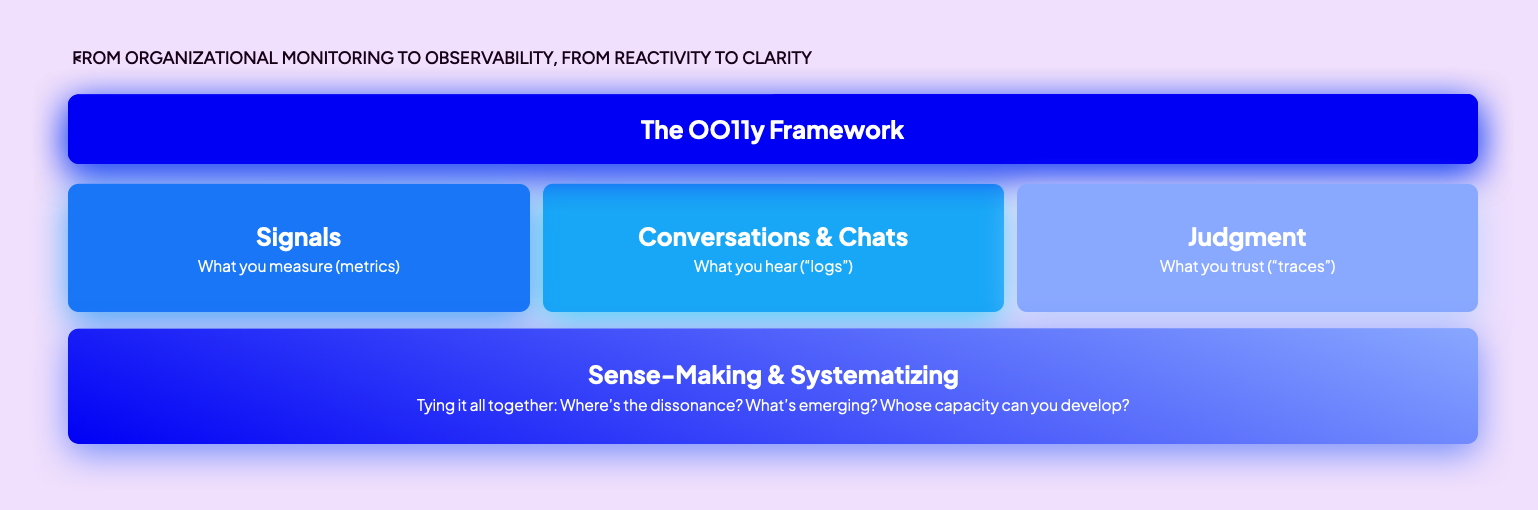
Just like technical observability rests on metrics, logs, and traces, organizational observability rests on three pillars that each give you a different type of information. You need all three:
Pillar 1: Signals (What You Measure)
Technical analogy: Metrics — quantitative indicators of system health, dashboards, trend lines.
Signals are the quantitative data that tells you whether things are generally healthy: delivery throughput, velocity trends, WIP, quality indicators, engagement scores, capacity allocation, attrition patterns.
What Signals are good for: Spotting trends, identifying drift, catching anomalies early, having data-grounded conversations with stakeholders and peers. Signals give you the “what”, what’s happening at a macro level across your organization.
What Signals can’t do: Tell you why something is happening. A spike in cycle time could mean a team is overloaded, a key person left, a dependency is blocked, or a manager is struggling. Signals raise questions; they don’t answer them.
The AI-era challenge: When throughput increases across the board, raw velocity metrics become less informative. Teams shipping more doesn’t mean they’re shipping the right things, or shipping well. The risk is that AI-inflated output metrics create a false sense of health. You need signals that tell you about productivity (we’re doing the right thing, well), but also give you a view into effectiveness (are we achieving our goals? is quality holding? are we building the right things?), and efficiency (are we avoiding waste?).
And then there’s what’s emerging: do you have any signals that would tell you something genuinely new is happening? A sudden increase in cross-team escalations, new types of requests from a team that didn’t have them before, unexpected changes in who’s reaching out to you, a team’s focus area quietly shifting. These are emergence signals: they tell you the landscape may be gradually changing.
Remember: a small number of signals you actually look at and act on beats 50 dashboards no one reviews.
Pillar 2: Conversations & Chats (What You Hear)
Technical analogy: Logs — detailed event records that give you rich, contextual information about specific things happening in the system.
Conversations & chats are the qualitative sensing mechanisms that give you the contextual, human information that numbers can’t capture: 1:1s with your reports, skip-levels, retros, team health checks, cross-functional check-ins, peer conversations, upward conversations with your own leadership, as well as the informal ones, like the friendly direct message or nudge in the office hallway.
What Conversations & Chats are good for: Everything that’s behind the data and between the lines: Understanding context, motivation, morale, interpersonal dynamics, emerging concerns, the “story behind the number.” Conversations give you the “why” and the “how are people feeling about this.”
What Conversations & Chats can’t do: Scale infinitely. Every conversation costs time and energy, your scarcest resources. And conversations are only as good as the willingness and ability of the other person to share accurately.
This is the pillar that gives you some of your most valuable data, and the one that’s arguably under the most direct pressure currently. The player-coach pull compresses the time directors have for conversations. When you’re back in the codebase or being asked to contribute more technically, 1:1s are often the first thing that gets shortened, spaced out, or dropped. The constant context-switching and multitasking (it’s so easy now!) means that being truly present has become so much harder to do. At the same time, this is also the pillar where the need is increasing drastically as there’s more happening in your org that metrics alone won’t explain.
When time and energy are scarce, conversation quality matters more than conversation quantity. This means three things.
First, identify which conversations give you the most unique information that you can’t get any other way. These are the irreplaceable conversations: the ones where you’re reading dynamics, sensing concerns, understanding how someone is really thinking about a problem, getting updates on what’s going on behind the scenes and what’s emerging. Status updates are not irreplaceable conversations and can be offloaded.
Second, offload what you can to async and automated channels. Structured weekly snippets from your reports (here’s how to move status to async; use it yourself and ask your direct reports to share information with you this way), team health pulse surveys, retro summaries that flow to you without you attending every retro, shared dashboards where teams self-report status. These aren’t replacing conversations, but helping you make better use of the conversations you make time for.
Third, protect the irreplaceable conversations.
Four directions of conversation & Chats:
Directors need conversational coverage in four directions, and most are only consistently covering one:
Down, with your reports and their teams. This is where most directors focus: 1:1s with direct reports, occasional skip-levels. The risk is relying solely on what your managers tell you, without hearing from other layers.
Across with peers and cross-functional partners. These give you the lateral picture: what’s shifting in adjacent orgs, where dependencies are forming, whether a risk your team sees is visible to the teams they work with. Crucially, across conversations are often your earliest warning system for emerging developments. These are usually the first to drop under time pressure because they feel “optional” and I hear so often that busy leaders don’t want to bother their peers. I think this layer is critically underutilized (more about working better with your peers here). They’re often where the most surprising and important information comes from.
Up, with your own leadership and manager(s), where you get strategic context: where priorities are actually heading (vs. where the last all-hands said they were heading), what pressures are coming that haven’t been announced yet. This is where you detect emerging shifts, from new strategic bets, changing expectations, to budget pressures, and get context.
Informal: That’s the heads-ups, DMs, hallway encounters, context shared unprompted, what you hear through the proverbial grapevine. It’s often the fastest channel for emerging information that hasn’t been formalized yet.
Pay attention to where you hear about new developments, shifting priorities, or emerging risks before they’re officially announced. If the answer is “nowhere” — that’s a critical gap.
Conversations should be generative, not performative. Many 1:1s devolve into status updates, with your report reading out what their teams are doing, your nodding along, nothing new is learned. A generative conversation surfaces something neither person knew going in. “What’s worrying you that you haven’t told me yet?” surfaces new information. “Give me an update on Project X” does not.
Pillar 3: Judgment (What You Trust)
Technical analogy: Traces, i.e., following a request end-to-end through a distributed system to understand how components interact and where things go wrong.
At the director+ level, you can’t and shouldn’t trace how every piece of work moves through your org. What you need is confidence that the distributed decision-making across your organization is sound. Are your managers challenging assumptions? Are they factoring in risks? Are they thinking critically about tradeoffs? Are they escalating the right things at the right time? Do they have a genuine handle on their areas, or are they executing without thinking?
Judgment gives you the ability to trust — or identify where you can’t trust — that the people around you are leading well. It’s observability of the decision-making layer, not the execution layer.
What makes Judgment uniquely hard is signal integrity: You’re relying on other people’s self-reporting about how they’re thinking, and some of those people may be unreliable narrators — not out of malice (there may be exceptions, but that’s all they are), but because of skill gaps, blind spots, fear, or a desire to look competent. This is the signal integrity problem: corrupted telemetry is worse than missing telemetry, because it gives you false confidence. A manager who reports green when things are red is more dangerous than a gap you know about. Identifying where your signal might be filtered, distorted, or incomplete is one of the most critical and difficult aspects of organizational observability.
When teams produce more and faster, the question shifts from “is stuff getting shipped” (Signals will tell you that) to, “is good judgment being exercised about what gets shipped and how?” When junior engineers save hours a week with AI, are they growing and learning, or just outputting more? When your managers are pulled back into technical contribution, are they still thinking like leaders about team dynamics, risk, and alignment? These are judgment-quality questions that neither Signals nor Conversations & Chats alone will answer.
Don’t rely on a single information source for anything that matters. Create contexts where multiple perspectives converge, like cross-functional forums, decision reviews, occasional structured observations (sitting in on a planning session, a retro, a design review to get a more direct read how the team thinks and operates), so discrepancies become visible.
Sense-Making: The Unifying Practice
Having all three pillars instrumented is necessary but not sufficient. You also need the discipline and space to synthesize what they’re telling you together.
Technical analogy: The observability platform, i.e., the system that correlates your metrics, logs, and traces into an integrated picture. Individual telemetry streams are useful, but the real power of observability comes from cross-referencing them. That’s what elevates your data into understanding.
Sense-making is the practice of asking: What are my Signals telling me? What am I hearing in my Conversations? What’s my Judgment read on the quality of thinking and decision-making around me? And critically: do they line up?
When your Signals say things are on track but your Conversations reveal anxiety, or when a manager’s narrative diverges from what cross-functional partners are saying — that dissonance is often the most important signal of all.
Beyond checking for dissonance in known areas, sense-making is where you ask the emergence question: What’s new? What’s different this week that wasn’t on my radar before? What’s shifting in the broader organization? Is something forming, think a new risk, a new dependency, a new expectation, that I haven’t named yet? It’s easy to spend all your attention on known issues and miss what’s just starting to form.
And there’s a layer underneath the data: your instincts. What do you have a weird or bad feeling about, even if you can’t fully explain it yet? Leadership instincts aren’t magic; they’re pattern recognition operating below your conscious analysis. Name it, write it down, and revisit it next week to see if it sharpened or resolved. Sometimes the instinct is noise. Sometimes it’s the earliest signal you have. (This is also a great way to check your own biases, by the way.)
Sense-making also includes defining what “healthy” looks like. For the areas you identified as your priorities, what does good look like? What does concerning look like? Having those baselines explicitly, even roughly, defined, transforms sense-making from “do I feel okay about things” to “are things within the range I’ve defined as healthy?”
Establishing your review rhythm
Sense-making doesn’t happen by accident. It needs a protected cadence. Here’s what I’ve seen work well:
Weekly self-review (15 min, personal, recurring): What did I learn across all three pillars? Does anything not line up? Emergence check: what’s new? Instinct check: what am I sensing? What’s the one thing I most need to pay attention to next week?
Monthly pattern conversation (with your leadership team): What are we seeing? What’s changed? What are we worried about? Are our priorities still right?
Quarterly reset: Have our baselines shifted? Has our context changed? What should we be observing differently?
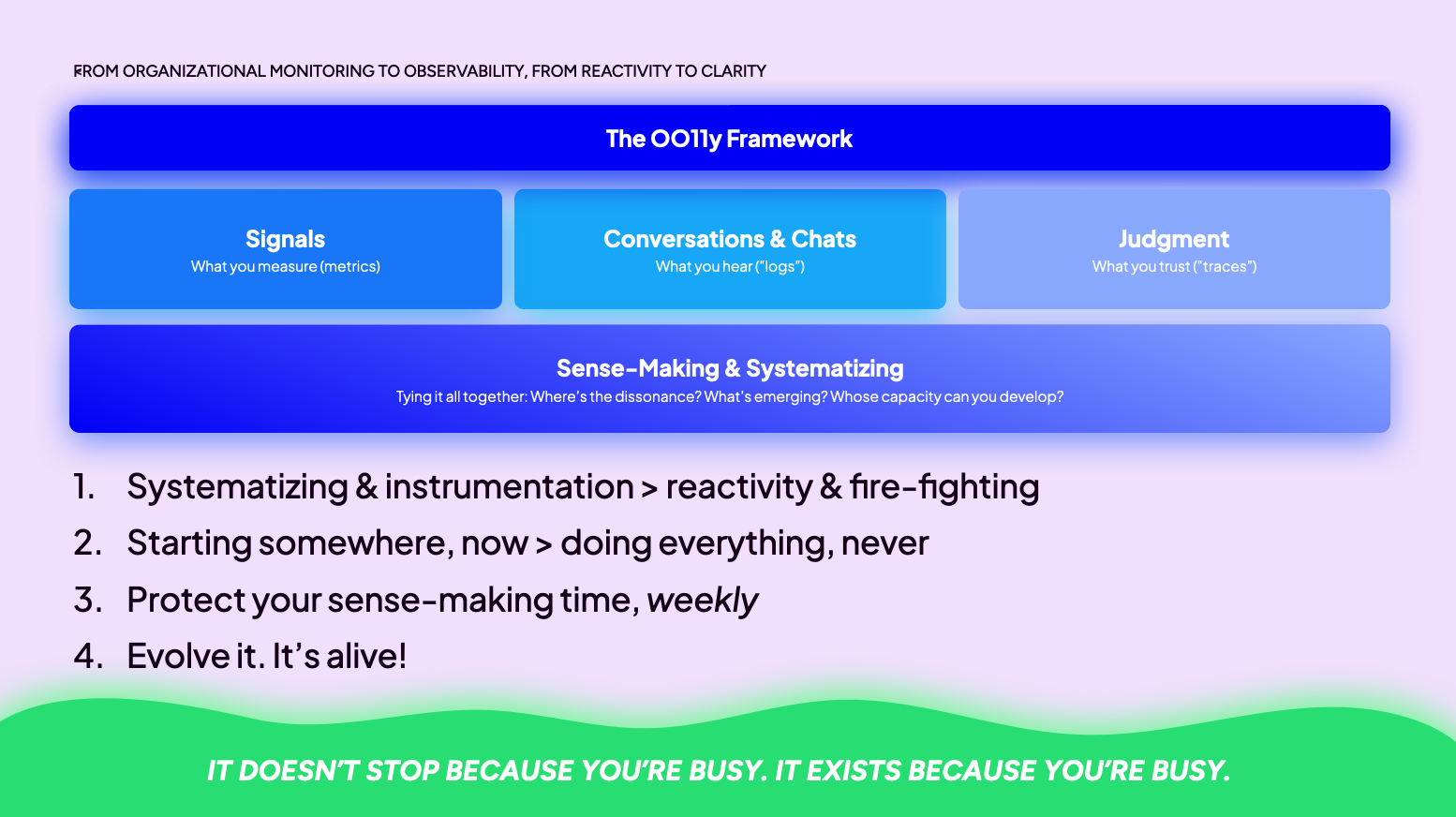
I know you’re busy, so remember: It doesn’t stop because you’re busy. It exists because you’re busy.
Systems > Heros
Organizational observability needs to be a system, not a function of your personal heroic effort:
Design instruments that surface information without requiring you to go hunting and chasing down information. Every piece of your observability system should bring information to you as a natural byproduct of how work happens, not because you happened to ask a specific question of a specific person at a specific moment.
Distribute observability across your leadership team. You can’t observe a distributed system from a single node. You need instrumentation distributed across the system. Grow your managers’ capacity for sensing, synthesizing, and surfacing information to you. This is a critical leadership skill that will help you make your own OO11y system more robust, and help them develop their own. Developing your managers’ capacity to observe their orgs well. and to communicate what they’re seeing accurately and proactively, is one of the highest-leverage investments you can make.
Starting somewhere, now > doing everything, never
Resist the tempation to get better at everything, immediately, that will just mean you never get it done. Start small:
Pick your focus. What’s the area where your visibility is weakest and the stakes are highest? Start there.
Audit your three pillars against that area. What Signals do you have (or not)? What Conversations are covering it (or not)? How confident is your Judgment read?
Close one gap. The smallest concrete step you can take this week.
Put your weekly review on the calendar. 15 minutes, recurring. Non-negotiable.
Identify one observability agent. Which person on your leadership team would benefit most from building their own sensing capacity?
The companion article, Building Your OO11y System, has the full set of self-guided exercises and a ready-to-use weekly review template to make your own.
Want to keep going and put it into practice?
For the practical exercises and a weekly review template, as well as a complete worksheet to download, see the companion article: Building Your OO11y System.