Mastering Middle Management: A Playbook for Succeeding in a Complex Role
Being in middle management is hard: You’re always in the middle between lower- and higher-level leaders who have drastically different motivations, purviews, and contexts. And your job is to translate and balance between them, and align them all to business goals.
This playbook is for you:
To give you the tools to navigate and thrive in this important, but often overlooked role. In each article of the series, I bring together the different contexts, motivations, and goals of everyone at these levels to give you the tools to be more effective as a middle manager.
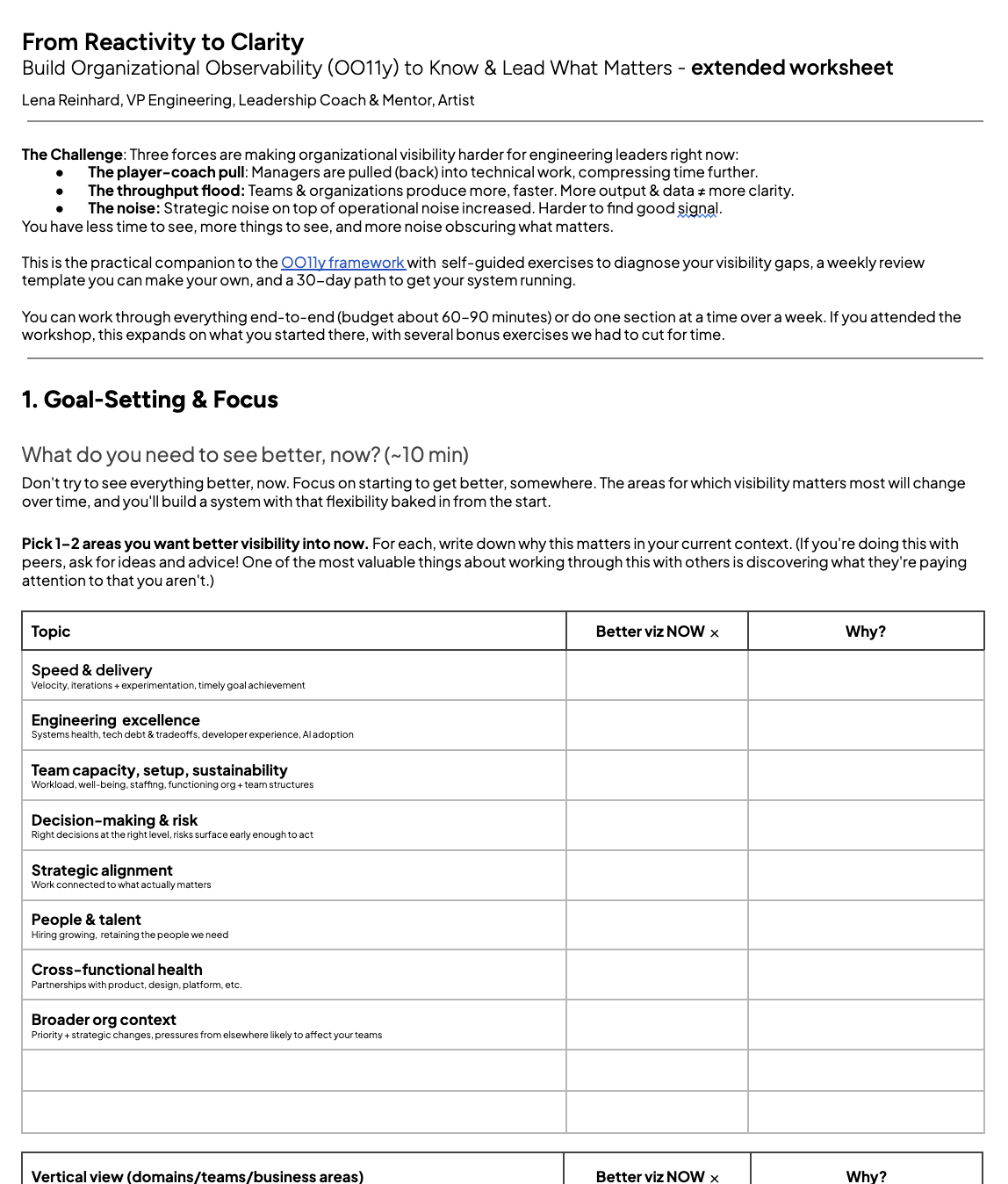
You know that you need better visibility into your organization. Now it's time to build the system to make it real. This extended worksheet walks you through self-guided exercises to map your Signals, Conversations & Chats, and Judgment, identify your biggest visibility gaps, and design a weekly review practice you can start this week. Includes a 30-day implementation path, bonus deep-dives on signal integrity and triangulation, a bank of generative questions to replace status-update conversations, and a downloadable PDF worksheet. Start fixing your visibility problems now, not next quarter.
Maximize your coaching or mentoring success with practical tips on building a solid partnership, optimizing sessions, and overcoming barriers. Learn what you can ask for and do before and during your work with a coach to achieve your professional goals effectively and confidently. Dive in to discover actionable insights and real-world examples to learn from other leaders.
What should engineering leadership roles in tech look like? We delve into the intense, decades-long debates, and look at how current industry changes affect responsibilities. Learn the crucial skills for effective leadership, and what people and technical leadership roles are right for your company.
Skip-level meetings can be a a catalyst for positive change within your organization, but too often, common interpersonal dynamics get in the way of leaders and employees making the most of them. Learn what these common challenges are and how to address them, to unlock greater team alignment and make your skip-level one-to-ones useful for leaders and employees alike.
Skip-level meetings offer direct communication between senior leaders and employees who report to middle managers. While they can be powerful tools for alignment and building trust, they can be awkward or ineffective if not conducted thoughtfully. This article offers a practical guide and templates for managers of managers to make these meetings beneficial for all involved.
Do you want to handle difficult conversations better? Are you clashing with higher-ups who can’t seem to get on the same page? Is your team not receptive to change? Here are questions from leaders and my answers for when you have to communicate a decision you disagree with.
Overwhelm is common among engineering leaders, but we don’t talk about it much. In this article, you’ll find common sources of overwhelm to help you recognize it in yourself, or support peers, and strategies from my work with many leaders dealing with this that can help you cope and get better.
This article 3-step guide will help you support your teams in recovering from difficult organizational changes. It shows how to shift from control to empowerment, involve your leadership teams, and how to show up as a leader for your teams. This guide will help you foster a culture of empowerment to drive innovation and success during difficult transitions.
Strategies for leaders guiding teams after tough changes like layoffs and reorganizations. We contrast high-control and high-empowerment approaches, and why you should resist the temptation of focusing on motivating your employees to process the change as quickly as possible, and what to do instead.
Read tried and tested strategies to foster a culture of empowerment, breaking patterns of micromanagement and heroism, and cultivating a mindset where all team members step up and treat challenges as collective opportunities for growth. Foster shared responsibility and collaboration to help your team/organization take more ownership.
"Why is no one stepping up to fix issues?", or "why is no one taking ownership?" are questions a lot of leaders ask themselves at some point. These symptoms are very often the result of organizations or teams that are stuck in an inertia trap: A range of organizational and team dynamics that have them stuck. Understand what's causing this trap will help you identify the most impactful actions to address it.
Pragmatism is a critical skill for engineers moving to more senior levels. Learn how balancing pragmatism and idealism can elevate your team's effectiveness, and practical tips to cultivate a culture of pragmatic decision-making, understanding economic implications, and managing capacity wisely.
Engineering leaders often ask me, “what engineering metrics are actually useful?”, or “which ones have worked for your teams?” This is where I share what metrics I found useful in various roles from engineering manager, to middle manager, to executive, and why.
Did your boss ask you to come up with metrics for your team(s)? Do you need to get your team on board with metrics? Learn the concrete steps you can take to choose and introduce metrics for your team(s) or organization and make them a success.
What do you do when you’re asked to execute on a company decision with your team(s) and direct reports, but you disagree with the decision? This step-by-step guide will help you navigate a tricky and complex situation.
Master the art of annual planning for your engineering organization. Use the steps in this article to create a strategy that helps you hit the ground running, embrace flexibility, and involve your teams for alignment. And: Get a FREE planning template!
Middle managers play a crucial role in fostering a "first team" approach among their direct reports, and doing so will help you elevate your role and your organization. Learn how to empower your leaders, build collaboration, and drive organizational change through the power of collective leadership.
Learn how to select the right metrics for your organization, implement them effectively, and get actionable insights. I cover how to involve your team in creating meaningful metrics, go from mere numbers to actionable insights, and create a culture of data-driven decision-making.
Struggling to implement meaningful engineering metrics in your team or organization? Understand the roles that metrics play at various organizational levels, and learn to use them as a powerful tool for improvement, alignment, and accountability. Whether you're a VP, middle manager, or line manager, this guide unpacks why metrics matter and how to make them work for you.
Working as a "first team" with our peer leaders means that we prioritize our peers rather than focusing mainly on our direct reports. Read about how this approach can help you bridge departmental gaps, level up as a leader, and based on what signs you can tell if leaders are operating as a “first team.”
Performance reviews are one of the most stressful times in any company, especially for leaders in middle management roles. In this article, we’ll help you align the contexts and motivations of all the people involved in this process, so you get the most out of performance reviews.
Are your engineering metrics doing more harm than good? Metrics aren't just numbers; they shape behavior and define culture. Choosing the right metrics can empower your team and drive performance. Learn how to set balanced, effective metrics that don't just measure, but also matter.
Do you feel stuck in the middle, as you’re navigating the tightrope between your CTO boss and the Engineering Managers reporting to you? I've been there. Learn proven strategies to balance different needs, fix communication, and steer your team to success. Your role is crucial—learn how to excel at it!
Leadership coaching has become increasingly popular amongst leaders at all levels in the tech space, which means there are a lot of options to choose from. In this article, I lay out how to find the right coach for your needs, and how to get the most out of your coaching experience.
Answer your boss's question about your engineering team's performance with this practical guide to effectiveness, efficiency, and productivity. It will help you understand your team's productivity and take steps with your teammates to become more productive while maintaining quality and innovation and taking your team along. With a free Engineering Productivity Cheat Sheet for download!
The topic of confidence at work is tricky - many of us want to feel more confident, but here’s the thing: Doing more, or developing more skills and experience won’t actually help you get there. So how is confidence actually built, and what you can do to feel more confident at work?
Struggling with Accountability in Engineering Teams? You're not alone. Learn how to build a culture that thrives on accountability—without sacrificing psychological safety. Marry your leadership values with accountability, overcome common misconceptions, and lead by example for a high-performing team. Master accountability, the unsung hero of effective leadership.
Read about what accountability is and isn’t, how to set up a culture of accountability, and learning from other departments, from my inspiring conversation with Jasmin Jackson-Irwin, a seasoned Revenue Leader who’s built enablement programs in hyper-growth startups.
Build a culture of high accountability in your organization. In the second article of this series, we’ll talk about what accountability is in the context of engineering organizations, lay out how to get started with building a culture of accountability and cover how it benefits your teams.
Accountability is key component of building high-performing teams, enabling team autonomy, and fostering psychological safety. And yet, many leaders ignore the topic - until they can’t. The first of three articles in my accountability series, I’ll help you spot low accountability in your organization.
Balancing and translating is your job.
Your boss is a senior leader, e.g. a CEO, CTO, VP, or Head of Engineering. Their role is to optimize for what’s best for the business as a whole.
The people reporting to you are line managers like Engineering Managers, Team Leads, as well as more senior engineers like staff engineers or Tech Leads. They typically have important low-level context but often struggle with connecting to the bigger picture.
And you’re in the middle, with low- and high-level context, and a mandate to deliver.
I know, because I’ve been there.
I understand where you’re at, because I’ve been there myself: As a co-founder, CEO, VP Engineering, Engineering Director, and Line Manager; I’ve been a middle manager, reported to one, and managed many middle managers (and learned how to be a better boss for them).
Now, in my coaching and workshop facilitation practice, I often hear from many middle managers who are expected to deliver results, but aren’t getting a lot of support, context, direction, or feedback. That’s why I created this playbook.
Enjoy reading it, and if you have feedback or would like to read about a specific topic, let me know!
I co-created many of these articles with Maggie Litton, a seasoned and formidable Engineering leader who’s held various Engineering Manager and Director roles (and I had the pleasure of being her boss for two years). We’ve both experienced the joys and challenges that come with it, and share with you what we’ve learned in our joint 35+ years of leadership.

Lena Reinhard (she/her, they/them) is a VP Engineering, leadership coach, mentor, and organizational developer partnering with leaders in the technology space. Having served as VP Engineering with CircleCI and Travis CI, and as a SaaS startup co-founder & CEO, Lena has dedicated her career to helping leaders and their organizations succeed in times of high change and challenging markets.
She has worked with a broad variety of companies at all stages, from startups pre-founding and bootstrapped, scale-ups, to late-stage/pre-IPO and VC-funded ventures, to corporations and NGOs.