The Making of “We Were Meant To Be”: a Keynote on Tech, Humanity, Crisis, And The Future
In May, I am going to give the opening keynote for a software engineering conference in Munich. This article is me trying something new: It’s a living document in which I share the messy, nonlinear, always most times sometimes chaotic process of building this presentation: A work log, resources I'm finding along the way, and whatever else comes up. This is for anyone who’s interested in the work that goes into such a presentation, and anyone who’s thinking about these topics too.
I'll keep updating the work log and resources sections (jump there) as I go.
I am Documenting this because I Love this creative work and Wanted to Give you a Glance Behind the scenes (And resources!)
I love writing and giving keynotes, especially when organizers trust me with big topics like this one (more on this in a second). It feels like such an honor.
And I love the process: It gives me an excuse opportunity to gather ideas and thoughts and inspiration in as many different places I like and weave a lot of (did I mention that I am, also, a weaver in reality?) different threads together, talk to smart friends, colleagues, and experts in their fields, research fields that I know nothing about (like, “nothingness” in 2015), read too many books, write and draw big concept boards, bring out my best pens and highlighters and handle SO MUCH stationery, and write enough content for a 12-hour presentation that I then need to whittle down to a solid 45 minutes.
In short, it tickles my creative brain.
The first time I got to give a keynote like this was for closing .concat() 2015. I got to deliver a few more keynotes over the years since, but the last years, my talks have focused much more on practical topics. I really like those too, but my approach for those tends to be very different. So, I’m excited.
A Behind-the-scenes look into a sometimes-messy creative process
Why share this publicly? A few reasons:
I love knowing how things are made. And I love seeing how people make things, how artists, craftspeople, researchers, film makers, or anyone really does what they do. I love peeking behind curtains. Maybe you do, too, so I thought I’d share a bit of my process (“process”).
I also want to model some transparency about the creative process in crafting a presentation like this. People often still have this idea that great speakers are "born with it," when in reality, most of what makes a talk work is invisible labour. Especially well-known public speakers like executives or politicians typically have entire teams behind them, including speechwriters. For most of the rest of us, nobody sees any of it because it's just not visible.
I've shared my messy process before. This time I'm doing it in real time, which is partly an accountability piece for me and partly, I hope, something that helps you feel less alone if you're wrestling with your own creative work, or with the bigger questions this talk is trying to address.
There are also some more personal aspects to this topic that I'm contemplating and very much wrestling with whether and how much to include them. The questions I keep returning to there are, primarily, what serves my audience and the message of the talk, and how vulnerable and open I want to (and can) be, especially in an industry where "being vulnerable as a leader" is always only a very calculated risk people take, and understandably so. At the same time, I know I will have a stage (literally) and am contemplating how I can use this platform to try and make as good of a difference as I can. This piece makes all of this a bit more complicated, I work through it with reviewers, friends, my therapist, and myself, but it’s part of this process too.
Lastly, I wanted to have an easy way to share the resources I’m using.
“We Were Meant To Be”: What the talk is about, And Why
Any of my talks usually begin with a mix of something I’m hearing, thinking, and talking a lot about with others, and this is no exception. Over the last 5-ish years, many of the conversations I have with people at industry events, clients, colleagues, and friends increasingly include topics like:
Fears about impending or going through acute layoffs
Struggles to find a new job, questions about what tech careers will look like in the future
Uncertainty about the future, not just of their job, but also of where the industry is headed
Concerns about hypes around AI
Increasing concerns about the immense harm that the tech industry at large is doing to humanity and our planet
And that’s not even mentioning the BIG HEADLINES we’re all seeing that seem to boil down to “the next robot is assigned to take your job” and “we’re all doomed, now.” It's a confusing time, and has been for a while. Many people feel very uncertain and it’s impossible to get definitive answers. That’s where I started.
Here's my abstract:
We Were Meant To Be
Maybe you got into tech because you were fascinated by computers. Or, among many people in our industry, you were drawn in by the promise a stable job and generous income, all while building useful things, and maybe even while working from home. Now, after return-to-office, rounds and rounds of layoffs, and the creeping of AI into our lives, the promises of tech careers have crumbled and job insecurity is high. Many of us feel uncertain about what all of this means.
Now what?
The abstract is grounded in tech careers because that’s a relatively common concern among many people. (N.B.: I also kept the abstract very vague and open on purpose for tactical reasons, so I don’t reveal too much beforehand and can keep open to the creative process.)
What it’s really about
At its heart, I'm trying to wrestle with this: In these confusing, uncertain, difficult, complicated time with one another differently, think differently, — when a lot of people are struggling, in and outside of tech; in a world that feels increasingly out of our control and is increasingly isolating us from one another, purely focused on extracting as much value as possible out of humans, animals, and the planet, creating incredible amounts of pressure and urgency on us, we direly need to gain perspective and space to think. We need to find ways to engage differently with one another, to think differently, to get creative, to shift our focus and pull our attention out of the algorithms that are trying to hold it 24/7. In these times, what does it mean to work in tech now? What does it mean to be a human in tech? How do we handle this no-answers time and all the uncertainty that comes with it? What does it even mean to be human? And what does it mean to live a life worth living amidst all this?
So, you know, small stuff.
Now what?
Those last two words in my abstract are the big question I'm hoping to answer. I have some ideas (and a list of 40+ more books to read that I am not quite sure I’ll get to (that’s a joke, I definitely won’t). And who knows what it will look like once I'm done wrestling everything that I have swirling around my head at the moment into a neat presentation deck that has a beginning, a middle, and an end.
Right now (March 15), when people ask me, “so what is your talk going to be?”, I tell them, I’m on step 2 of my three-step plan:
Step 1: Idea
Step 2: ???
Step 3: Super talk
just so you know what you’re getting yourself into here:
The person writing this is also the person who, as part of her first article about “how to prepare a tech conference talk”, in the section “DEALING(S) WITH FEELINGS”, brought you the following just ten years and one month ago:
Well, almost exactly same person, except that I’m ten years and a month older and so much wiser and smarter and also with a much better hair care regimen (I live in an area with very hard water, the secret is rinsing it with apple cider vinegar!).
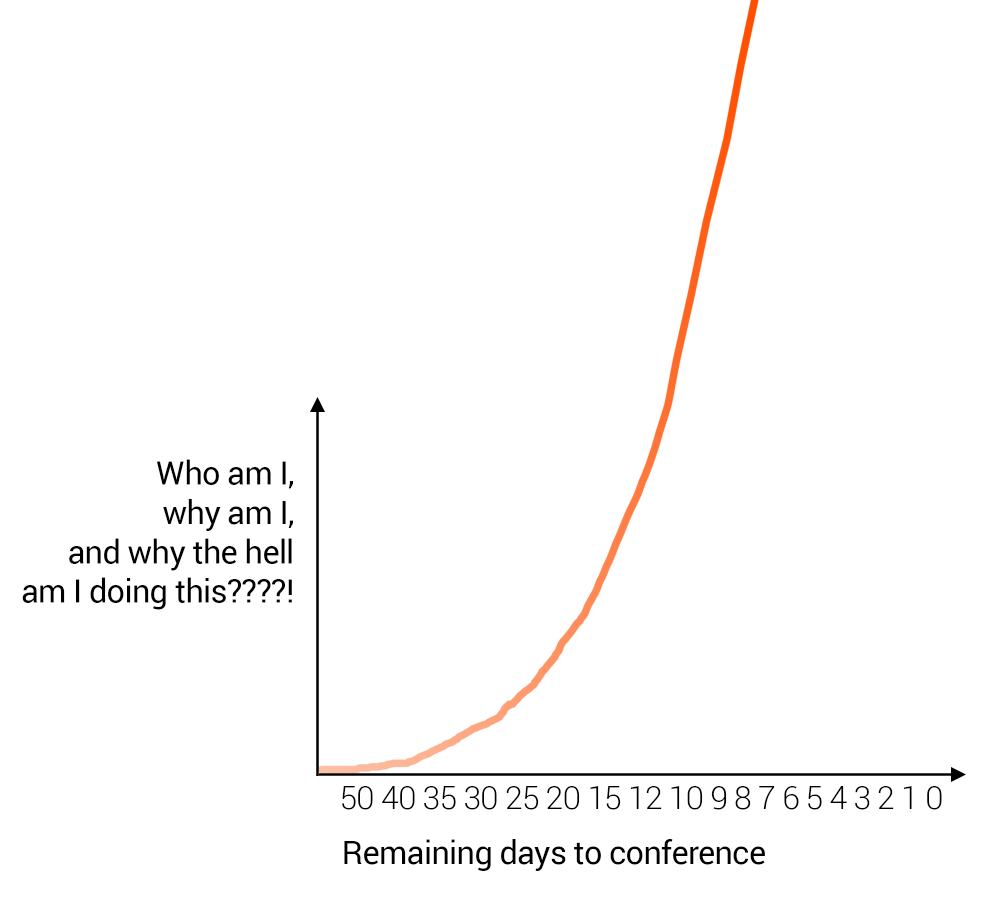
“Who am I, why am I, and why the hell am I doing this????!” – The feeling of questioning myself, my skills and abilities, the whole idea of being a public speaker. The idea of being completely inadequate for this task, and not being able to do this AT ALL.
Mostly, this feeling is a strange sauce of nervousness, time-pressure-induced stress, sometimes bad planning or organisation, imposter syndrome and general self-consciousness.
It usually pops up several times throughout the whole talk preparation process.
I have illustrated this development with this tiny, mathematically completely incorrect graph.
Well, almost exactly same person, except that I’m ten years and a month older and so much wiser and smarter and also with a much better hair care regimen (I live in an area with very hard water, the secret is rinsing it with apple cider vinegar!).
If you're wrestling with similar questions, I hope following along helps you feel less alone.
P.S.: I love hearing From you!
If you have any thoughts on these many topics or want to send some encouragement, cat/dog/cute animal memes, nature facts, your favorite non-tech-related thing or something artsy or creative that gives you joy, reach out!
I may not be able to answer personally because as you’ll see below, I’m spending pretty much all my time working on this, but my colleague Sly and I will definitely read your email.
—
The following sections get updated regularly
Last update: March 20, 2026; note: After this date, I started logging everything chronologically in the work log below, to make it a bit easier for me to keep this up-to-date and for you to follow along or see updates.
Resources
Everything I've been reading, listening to, and finding useful (or at least thought-provoking) along the way. Not all of these are endorsements (!). Some made me angry, some made me sad, some shifted my thinking, and all of them are in some way contributing to the galaxy-brain-ness I’m going through.
I made a deliberate choice early on not to only focus on tech- and adjacent books, but instead follow what sparked my curiosity. Some of my best thinking (I think) came from books that at least at the surface have almost nothing to do with tech.
I'm sharing the lot because you might find them useful for your own thinking; most are in English, a few in German only (sorry).
Articles
Child's Play — Sam Kriss, Harper's (March 2026). This one just made me very sad. It was the latest iteration of the same dynamic that I feel I've been seeing forever — and I've only been in tech for 16 years.
Internet Nihilism Crisis — The Atlantic (February 2026). Put into words a lot of what I'm feeling at the moment when I open any kind of internet device.
Podcasts & interviews
https://www.nytimes.com/2026/03/20/opinion/ezra-klein-podcast-naomi-klein.html
Endless Slop, Cancer Cures, or Robot Apocalypse? — Derek Thompson on Our AI Future
Rebecca Solnit interview — The New York Times Magazine
Books
I post all my book updates on my Goodreads profile too.
Let This Radicalize You: Organizing and the Revolution of Reciprocal Care by Kelly Hayes, Mariame Kaba, Harsha Walia. It's beautiful and hope-giving and practical (3-16)
The Body Is a Doorway: A Memoir: A Journey Beyond Healing, Hope, and the Human - Sophie Strand
Against Purity: Living Ethically in Compromised Times — Alexis Shotwell. — Really enjoyed this. Puts the finger on a very good and complicated question we're all facing now.
You Have a New Memory: Essays — Aiden Arata. One of my favorite reads recently.
Will There Ever Be Another You — Patricia Lockwood. Also loved this.
The Age of Extraction: How Tech Platforms Conquered the Economy and Threaten Our Future Prosperity
— Tim WuThe Body Digital: A Brief History of Humans and Machines from Cuckoo Clocks to ChatGPT — Vanessa Chang. Very good.
The Sirens' Call: How Attention Became the World's Most Endangered Resource — Christopher L. Hayes
The Extinction of Experience: Being Human in a Disembodied World — Christine Rosen
A Whole New Human: Ten Ways We Must Evolve to Survive and Thrive in the AI Age — Derek Rydall
When You Care: The Unexpected Magic of Caring for Others — Elissa Strauss
Death: The End of Self-Improvement — Joan Tollifson
Culpability — Bruce Holsinger
The Age of Surveillance Capitalism: The Fight for a Human Future at the New Frontier of Power
— Shoshana ZuboffHope for Cynics: The Surprising Science of Human Goodness — Jamil Zaki
Against the Machine: On the Unmaking of Humanity — Paul Kingsnorth
You to the Power of Two: Redefining Human Potential in the Age of Identic AI — Joseph Bradley
Life 3.0: Being Human in the Age of Artificial Intelligence — Max Tegmark
In German
Faktor Mensch — Kristin Weber
Angewandte Ethik und Technikbewertung — Michael Funk
Technik als Trost: Verheißungen Künstlicher Intelligenz — Stefan Selke
Computer und Gesellschaft: Roboter und KI als soziale Herausforderung — Michael Funk
Gemeinsinn: Der sechste, soziale Sinn — Aleida Assmann
Die Zukunft ist endlos: Denken in der digitalen Welt — Roland van der Vorst
Disruption: Die Ideologie der Tech-Oligarchen und das Ende der Demokratie, wie wir sie kennen — Jannis Brühl. Solid overview, though I don't think I was the target audience.
Previously
How to prepare and write a tech conference talk — my previous write-up on my talk prep process from 2016.
Work log
This is the raw-ish log I'm keeping as I work on this keynote. It's not polished, that's the whole point. Newest entries are at the top, including on the same date.
Last updated:
18 April
End of day: Speaker notes total: 7106 words → 47m 52s
🎉🎉🎉🎉🎉🎉🎉❗ I’m so excited. After weeks of mostly cramming talk work in between other things, I finally had some focus time and reworked the whole presentation a few times between yesterday and today. I killed many beloved darlings (☠️), I kept them in an older version and may at some point share them in a director’s cut version. My goal was to get the voice track finalized by end of this week and it looks like I’m almost there. I’m so glad.
17 April
End of day: Speaker notes total: 9867 words → 67m 17s
16 April
End of day: Speaker notes total: 11,685 words → 79m 24s
It’s been a busy week! I did two more run-throughs and have a solid structure, now my main task is really getting to the core; a challenge, when there’s so much I would like to say. I also attended a conference and listened to multiple panels discussing the state of tech and society.
Read:
https://www.theguardian.com/technology/2026/apr/14/ai-productivity-workplace-errors
https://www.poetryfoundation.org/books/reviews/159013/how-to-make-an-algorithm-in-a-microwave
https://newsocialist.org.uk/transmissions/ai-the-new-aesthetics-of-fascism/
Books:
Start of day: Speaker notes total: 13,448 words → 91m 09s
9 April
End of day: Slide content total: 2447 words → 16m 49s; Speaker notes total: 7519 words → 50m 38s
Start of day: Speaker notes total: 2192 words → 16m 07s
7-8 April
I’ve been developing some ideas for artwork for the presentation. I do some story-boarding and experiment with a few digital art styles to get a feel for what could work. At the moment I’m looking at drawing 15-20 small illustrations; the next step will be making a few more sample drawings.
6 April
I’m restarting the deck again towards v4. Start of day: 0 words. End of day: 3,165 words.
Spent the last days doing lots of reading and thinking and then more reading:
Active Hope: How to Face the Mess We're in without Going Crazy, Joanna Macy
The AI Con: How to Fight Big Tech’s Hype and Create the Future We Want, Emily M. Bender
Program or Be Programmed: Ten Commands for a Digital Age (2024 edition), Douglas Rushkoff
Everyday Utopia: What 2,000 Years of Wild Experiments Can Teach Us About the Good Life, Kristen R. Ghodsee; I read this in 2024 and revisited a few chapters this time
The Atomic Human: Understanding Ourselves in the Age of AI, Neil D. Lawrence
Taming Silicon Valley: How We Can Ensure That AI Works for Us, Gary F. Marcus
Technopoly: The Surrender of Culture to Technology, Neil Postman
The Attention Merchants: The Epic Scramble to Get Inside Our Heads, Tim Wu
Tech Agnostic: How Technology Became the World's Most Powerful Religion, and Why It Desperately Needs a Reformation, Greg Epstein
The Algorithm: How AI Decides Who Gets Hired, Monitored, Promoted, and Fired and Why We Need to Fight Back Now, Hilke Schellmann
2 April
Listened to The internet sucks, and Congress might make it worse - Panic World
31 March
EOD slide content total: 11564 words → 77m 06s
I meet with my coach to discuss some of the elements of the talk, I want to better understand my own motivations and what I’m really trying to convey.
I begin incorporating the feedback I got yesterday and on Friday.
30 March
1322 I ran another walk-through with a colleague based on v3. Running the numbers now, I’m realizing that I made much more progress than I’d realized - and I also need to scale back immensely. The walk-through was a very loose storytelling session with me improvising a bit over the slide deck I have. Saying things out loud this early in the process is really helpful for me, it gives me a much better feel for how saying them makes me feel and for the overall content structure. Slide content total: 9,330 words → 62m 12s
Resources:
The Means of Prediction: How AI Really Works, Maximilian Kasy
https://www.wired.com/story/silicon-valley-china-996-work-schedule/
https://www.truthdig.com/articles/the-acronym-behind-our-wildest-ai-dreams-and-nightmares/
https://www.theatlantic.com/technology/2026/03/ai-boom-polycrisis/686559
28 March
Study, 2003 (!): Technology as a contributor to isolation and loneliness in contemporary culture
Study, 2025: Loneliness and Solitude in the Digital Age
Listened to https://www.vox.com/podcasts/483724/agentic-ai-hype-cycle-reactions-alignment-problem-dangers-explained
27 March
1609 I have deprecated v2, it became too expansive to handle. Farewell, thanks for taking me where I am now. I began incorporating the feedback from this morning and rebuilding from scratch towards v3. Slide content total: 1,503 words → 10m 01s
One of the hardest parts about any such talk, or any other endeavor of conveying something, but specifically with this talk, is that there is SO MUCH that I WANT say, and so much more that I COULD say. And events, debates, stories that feed into it are unfolding so fast at the moment that it feels like even if I finished writing this presentation now, I would very likely miss critical developments that will only take place over the next two months between now and the event, which, of course, means that I will need to make this talk a just-in-time delivery. (And just in case the sarcasm didn’t translate super well, that last part was sarcasm.) I also know very well that one of the reasons I’m being asked to do this at all and in the first place is to identify not everything there is to say (gosh I wish, because then I might be done already), but the part that is [insert qualifiers of your choice here: Important to me, important to the audience, useful, interesting, definitely not boring and certainly worth asking many people of their time for]. I’ve always felt this tension strongly, especially as my talks tend to be about areas that I have THOUGHTS (yes in all-caps) on. But this whole topic continues growing so fast that it’s making that challenge even more visceral.
And yet, so little time.
1130 I give a very poorly-delivered, haphazardly-shifting-content-as-I-go version of this to a friend who’s also in tech. They give very excellent feedback and one of the bits that excites me the most is that the idea I had last night around making the metaphor more central to it all actually lands with my friend. They also tell me really politely that my delivery was abhorrent, but that that’s okay because they’ve seen me speak before and know that I will be able to make that part work. Lol.
1107, start of day: Slide content total: 11,316 words → 75m 26s. It’s been a really busy week and I haven’t had much time to actively work on it. Spent a few hours over the course of the week in my notebook rethinking what I want the core idea of it all to be. I’m also realizing that one of my key metaphors has potential and may have much more more impact if I move it to the beginning of the talk already and connect to it multiple times throughout. I feel giddy once that clicks. Spent a little time last night and 20 minutes this morning trying to translate the new idea into the slide deck (v2), so I would be prepared for a walk-through with a friend.
Read in the last days:
21 March
1858: I finally have almost all content in the slide deck at least in directional form. The structure starts feeling really good (I’m also sort of just waiting for it to crumble again, as it tends to do, heh.) I’m off to a classical concert now; I feel a bit too tired and kind of just want to sit in front of the tv, but I made a resolution to make more space for art in my life and not let it be taken over by all many complex and pretty awful things that I spend much of the day thinking about. Slide content total: 9861 words → 67m 14s.
1437: I’m restarting with a new slide deck to implement the new, much clearer structure, moving many elements around and beginning to merge duplicate content and consolidate in a few places. I’ll have three main sections, 1 and 3 will be pretty long, with 2 as a “bridge.” Right now, in my editing process, I’m at the end of my main block 2. Slide content total: 6742 words → 46m 27s.
1126: I’m still in the “lost at sea”-stage as I begin the content work today. The first two main parts I feel pretty good about, but I really struggle to get to a clear message for the last part; probably just a good reflection of how I feel about the exact thing I want to talk about. And I feel overwhelmed because I have so many ideas but don’t know yet quite what exactly I want to say. I get another drawing board (this is the 3rd, I’m about to run out - usually don’t use this many drawing boards in parallel!); I write “community” and don’t know what else to write, so just this words sits on the board by itself for over an hour (ironic).
I go over my existing notes across the boards, a notebook, and all the digital content I have by now. I start pulling out high level key points and add them to the “community.” At some point, I find key themes, order them, re-read it all and suddenly feel goosebumps. That happens sometimes, I also had a brief moment like this when I talked to my friend the day before yesterday. It’s always a good sign that the message is starting to come together, become clearer, and, most of all, evokes something in me. (As you’ve probably read so far, getting there is often not the easiest part.)
Spend the morning synthesizing my friend’s feedback and working it into the slides as notes. I also update my script to generate output that will allow me to track the progression of it better over time.
Listened to We’re All Living in the ‘Mirror World’ Now - Ezra Klein interviews Naomi Klein
Start of day: Slide content total: 13567 words → 90m 27s.
20 March
Yesterday, I ran a walk-through with a former colleague turned close friend. It’s very clear that the last part (the real “now what?” of it all) still needs more work; that’s not surprising, but now I also have much better ideas for how to do that.
Other stuff: In the morning, I get some keys on my computer fixed.
Start of day:Slide content total: 13397 words → 103m 03s
16 March
2218: I update this log. I spent a lot of time today thinking in circles, I’m struggling hard with the framing and core idea for the last third of the talk. I just sat down with my big piece of paper and the highlighters again, and I think I may have an idea. Slide content total: 12233 words → 94m 06s (oh boy)
I also read Let This Radicalize You: Organizing and the Revolution of Reciprocal Care by Kelly Hayes, Mariame Kaba, Harsha Walia. Loved it.
More reading, I'm increasingly enamored with Technik als Trost: Verheißungen Künstlicher Intelligenz — Stefan Selke. I look up the author, Selke is a sociologist, transformation scientist, and professor for "societal change." The book also contains a really interesting chapter about the tension between science-fiction narratives and "real" narratives about AI. A quote, translation by me:
“It is wrong to assume that technology has no alternatives and that the future is no longer in our hands. Equally wrong is the assumption that life is a malfunction and therefore requires constant optimization. Dystopian effects can occur. But they are always the endpoint in a long series of decisions that are consistently prepared and ultimately made by human actors. This human influence on AI should therefore never be denied, because otherwise, responsibility for our own future is denied. This is precisely why ethical questions cannot wait. However, they do not stand in the way of progress; rather, they are the foundation for progress that truly deserves the name.”
1345: I had borrowed an eBook from my library through Libby that I really enjoyed; it got returned over the weekend, I had slept on the deadline. I was really disappointed at first because there were several quotes I wanted to note, but didn't get them done in time. UNTIL I learned, through some obscure Reddit thread, of course, that you can export highlights from books you borrowed in Libby, in CSV format nonetheless! Rejoice! What a time to be alive!
0945: Start the day with an hour of work before an appointment that somehow adds 1,854 words. Slide total: 7407 words → 56m 59s
15 March 2026
I publish this post.
I end the talk work day at5,802 words and 71 slides.
I keep forgetting to update this. I struggle with my focus because I get distracted by minor stuff like having to open my inbox to get a one-time password to access the white-boarding app where my talk structure template lives. I have ADHD, don’t make me walk into my inbox when I have other stuff to do! Please!
Spent a little time digging into structures for storytelling, only to remember that I know them well enough, and realize that my issue is rather that it’s mostly an avoidance tactic: I've reached the point of the presentation that's the hardest for me (by far) and I'm grasping for things to hold on to and distract myself. I realize I need to get back to the questions at the very heart of this. (And close the storytelling books.)
I also created a script that runs word count breakdowns in Apple Keynote for me (the lack of that feature was what made me switch to Google Slides a few years ago; Alice Keeler made an excellent plugin for that, highly recommend!). Now I have a nifty script that tells me that right now, I'm at 5,553 words, i.e. around 43 out of 45 minutes. I write my keynotes for 130 WPM; my delivery tends to be more towards 150–180 for shorter talks, but I don't want to rush myself, especially with this 45-minute talk. This means I'm technically at time.
Content-wise, I'm about two-thirds in. I feel okay about that for now; I'm still working in the Ghost Deck and in expansion mode, mostly focused on building a narrative with the key points and sub-points.
Rest of the week (9–14 March): 9 hours, plus a few hours of reading that didn't get tracked.
8 March 2026
Daytime. Listened to a podcast episode. I realise I need to spend less time on the doom, hype, and bullshit; it's draining my soul and blocking my creativity, and encroaching like an invasive species on my small hope. [March 15, editor’s note: Yeah you silly goose, congratulations for arriving at a conclusion you already had in January.]
Can't sleep, so I read this book.
The funny thing about having signed myself up to give a keynote about what to do about the uncertainty stirred up by how the tech industry has changed (including, of course, AI) is that I could EASILY make it my full-time (like 24/7) job for the next two months JUST TO KEEP UP WITH THE FEW NEWS SOURCES I FOLLOW and still not have enough time.
I realize that I've only got around 9 weeks or so left. Or rather, two months and a bit; sounds better. Mild panic sets in again. I resolve to spend tomorrow actually drafting my ghost deck — I really need to get going with that. I'm very concerned that more input is just going to lead to me doing even more galaxy-braining. It's never been good for me to get all in my head with my talks.
Most of all, I know that all my reading isn't just fueled by my innate curiosity and interest: I have been feeling a bit insecure about what is currently one of my key narrative pillars (it's a very personal one and I'm unsure how much of it I want to put into the world) and I need to start actually testing it to see if it holds and if I'm okay with using it — or find a different one, stat.
7 March 2026
3 hours. Listened to Endless Slop, Cancer Cures, or Robot Apocalypse? — Derek Thompson on Our AI Future and a Rebecca Solnit interview in the NYT. I didn't really want to work on the talk today at all, but ended up sliding into it as I went through my podcast feed and saw these episodes. Listened to both on a trip to the farmers market in the sun.
Later, I wanted to dive deeper into some things that listening to those interviews had brought up for me; instead, I procrastinate by finally launching a speaker coaching offer landing page — something I've been meaning to do since last March. Lol.
6 March 2026
2 hours. I run the numbers and realise I have 39 books that I still want to read in preparation for this. Even with my recent speed reading improvements, I have a hunch that that might not be possible. Even worse, I fear that I'll only find even more interesting ones. Oh boy.
5 March 2026
4 hours. More board notes and reading. One book infuriates me — note to self: research authors beforehand next time instead of just buying and diving into books with great titles. Finished reading Child's Play by Sam Kriss in Harper's and good god, what have we come to.
4 March 2026
8 hours. Inspired by a conversation in the morning, I end up "A Beautiful Mind"-boarding the hell out of this until midnight
I apologize for the blurry excerpt.
25 February 2026
5 hours of reading.
22 February 2026
5 hours. Read one book — very good.
20–21 February 2026
4 hours across both days. Finished a few books, including one that was a solid overview but I don't think I was the target audience.
18 February 2026
Been adding loads to my "random notes" file. Finished Against Purity (loved) and another book (disappointed).
I gave a rundown of the first two-thirds of my narrative arc idea to my colleague last week; we recorded it. I haven't reviewed the transcript but instead just sat with the idea of it for a bit, and the longer I do, the more I like its potential.
Next up: Finish my foundational work (audience journey, emotional arc), then create a first ghost deck. Feeling good about it overall, though I'm super nervous about the timeline given my limited capacity and how hazy it all still feels; that's why I want to push hard to make it concrete (→ ghost deck) ASAP.
10 February 2026
By this point: 12+ hours of reading (two books, plus multiple podcast episodes and Reddit discussions — having mentioned those just now, 12 is probably not enough).
23 January 2026
45 minutes in the morning from 4 AM, not being able to sleep. 45 minutes in the afternoon writing out my big hypotheses.
21 January 2026
45 minutes of conceptual notes; gathering ideas for one narrative arc; audience research.
8 January 2026
Dug out another 7 books on tech and its impact. Once I'd added them all to my eBook reader, I realized that this may be a tempting but not useful approach (at least not to this degree). I need to ground it in the human experience, in the calls I want to make to arms, art, community, and less in the doom. Which also means I may need to consume less (about) doom. [March 15, narrator voice: You sweet summer child, you had such a great plan and then forgot about it.]
7 January 2026
Went over my book lists again to highlight more books that I want to read. The more reading material I gather, the more I think that the heart of what I actually want to cover lies elsewhere. Maybe somewhere with some goddamn peace and quiet.
I haven't done the work yet to get into what I want people to feel, do, take away from this, etc. Starting to think I should do that ASAP.
Earlier
~10 hours of various reading, note-taking, and discussions before any of this was logged.