How to Understand, Measure, and improve productivity in your engineering team
This article was last updated on April 8, 2024.
Article summary
This article helps you deeply understand software engineering productivity, effectiveness, and efficiency, how to measure them, and gives you concrete steps to help your team improve.
Talking about productivity, effectiveness, and efficiency in software engineering feels uncomfortable for many people, and understandably so. That’s why my approaches are all designed to make these topics accessible to everyone, so you can take your teammates along for the journey.
Definitions:
Effectiveness is about “the right thing”: Your goal, and what an organization aims to achieve
Efficiency is about doing things the “right way”: The steps you and your team take to achieve our goal, and avoiding waste of resources like time and money.
Productivity represents their blend: Doing the right things, and doing them the right way.
Companies make choices about what to optimize for between efficiency or effectiveness, or a balance of both (productivity). These choices often change over time.
Steps to take to lead your team towards higher productivity:
Know your organization: Understand what your business is prioritizing so you can take your next steps aligned with those goals
Define metrics: Pick a set of metrics that will help you know that your team is moving in the right direction, and make adjustments with them as needed
Understand where you’re at: Find out with your teammates where you can optimize the way you’re working
Make it real and repeat: Keep talking with your teammates about productivity and how you can improve together.
Watch out for condition changes: As your company changes its goals or strategy, adjust the ways you and your team are working together
Regularly speak with your boss and team to validate your choices: Make sure they all understand what you’re trying to do, and adjust along the way
Free Engineering Productivity Cheat Sheet

Download my free Engineering Productivity Cheat Sheet here to help your software engineering team become more productive, in a way that makes sense to them!
Leading in a tech downturn can be hugely challenging for leaders and teams. In this article, I outline steps that will help you change how you think and operate to become the leader that your company and your team need during times of uncertainty.
talking about productivity, efficiency, and effectiveness in engineering is… complicated
Over the last years, many CEOs quoted a “need for efficiency” as the reason for layoffs. Mark Zuckerberg of Meta even dubbed 2023 the “year of efficiency”. These words can make software engineers queasy, understandably so; here are some common reasons why:
Big words, little clarity - words like “efficiency” or its cousin “effectiveness”, let alone “productivity” are abstract with little shared meaning. “Business speak” is something that a lot of engineers find a bit off-putting, especially when words get thrown around that no one seems to really understand or even try to explain. They’re also
Scary words that many people almost instantly associate with layoffs and other news headlines.
Many engineers have made bad experiences with many of these words, and, even more, seen them used as excuses or explanations for poor behaviors, used without much explanation, and often as empty management speak with little to no meaning. Similar to engineering metrics, many engineers get quite concerned even at the whiff of them.
Many people dislike talking about money - talking about money is uncomfortable. It’s taboo in many societies and cultures (even at work). In the last decade, money has been cheap and many companies were able to spend a lot of it without focusing on the impact of this spending; that’s changed in the last year (read more about why and how here).
You weren’t trained for this - many leaders and managers never received formal business training when promoted into these roles, and business topics are often inaccessible.
It’s personal - money is also personal. We all need to make it to survive.
People vs. spreadsheets - many of us got into the work we do as leaders for the people and tech, not the spreadsheets.
That’s a big reason why this article exists: To make these topics more tangible for anyone in software engineering. After all, thinking about efficiency, effectiveness, and productivity is part of any leader’s role, no matter if you manage people or are focused on tech. So let’s talk about what these terms mean and how you can make them a tool in your manager toolkit that you know how to use, dare I say, effectively.
Defining efficiency, effectiveness, and productivity in engineering
To help us think more about the effectiveness, efficiency, and productivity, I will introduce two characters:
Defining efficiency

Calculator Capybara
Capybaras are the world's largest rodents. They live on land and in the water - they have partially webbed feet, making them great swimmers!
Capybaras are able to navigate any terrain to figure out the best path forward, and represent efficiency.
Efficiency is about the how: How are we moving? Are we doing things the right way? How are we allocating our resources, such as time, capacity, or skills?
A common misconception is that efficiency is not about divesting or spending less, but about how you allocate resources, such as time, capacity, or skills. Instead, it’s about avoiding waste along the way - waste can be things like money, time, tech, but also mental focus.
Efficiency can be measured by:
Waste-limiting: We don’t waste time, mental capacity, technical capacity
Culture-building: we collaborate in productive and useful ways
Output: We’re appropriately productive in a timely manner
But of course, we can only figure out the best actions to take when we know where we’re going - and that’s where effectiveness comes in.
Defining effectiveness

Idea impala
Fun fact: Impala grows just <5 ft long, but can leap 32ft!
Idea impala represents the leap - and stands for effectiveness: The goal, the “right thing”, connected to our strategy and the big picture: What we’re going after, and why. In short, we help our company achieve its goals. Achieving them means we’re effective.
Effectiveness can be measured by:
Alignment: We have a goal and all share it
Structure: We’re all clear, have access to the information everyone needs, etc.
Goal attainment: We achieve what we set out to do in the quality we want
Defining Productivity
Productivity tries to encompass both: The ingenious blend of efficiency and effectiveness, crafting an environment where teams not only do the right things but do them right, with minimal waste and maximal impact.
Leaders play a huge role in steering their teams toward higher productivity. It involves more than just pushing for increased output; it's about cultivating a culture that values smart work as much as hard work. This means optimizing workflows, eliminating bottlenecks, and automating repetitive tasks to allow the team to focus on innovation and problem-solving—as well as negotiating with stakeholders and aligning with senior leaders to make optimal decisions.
Every day, you and your team make countless big and small decisions to help you achieve your company’s goals (effectiveness), and achieve them in better ways than before (efficiency); in combination, you’re productive.
Now of course you can walk down the path towards your goals, or you can buy a helicopter and just fly your entire team up to the goal on the mountain top. Those choices are significant:
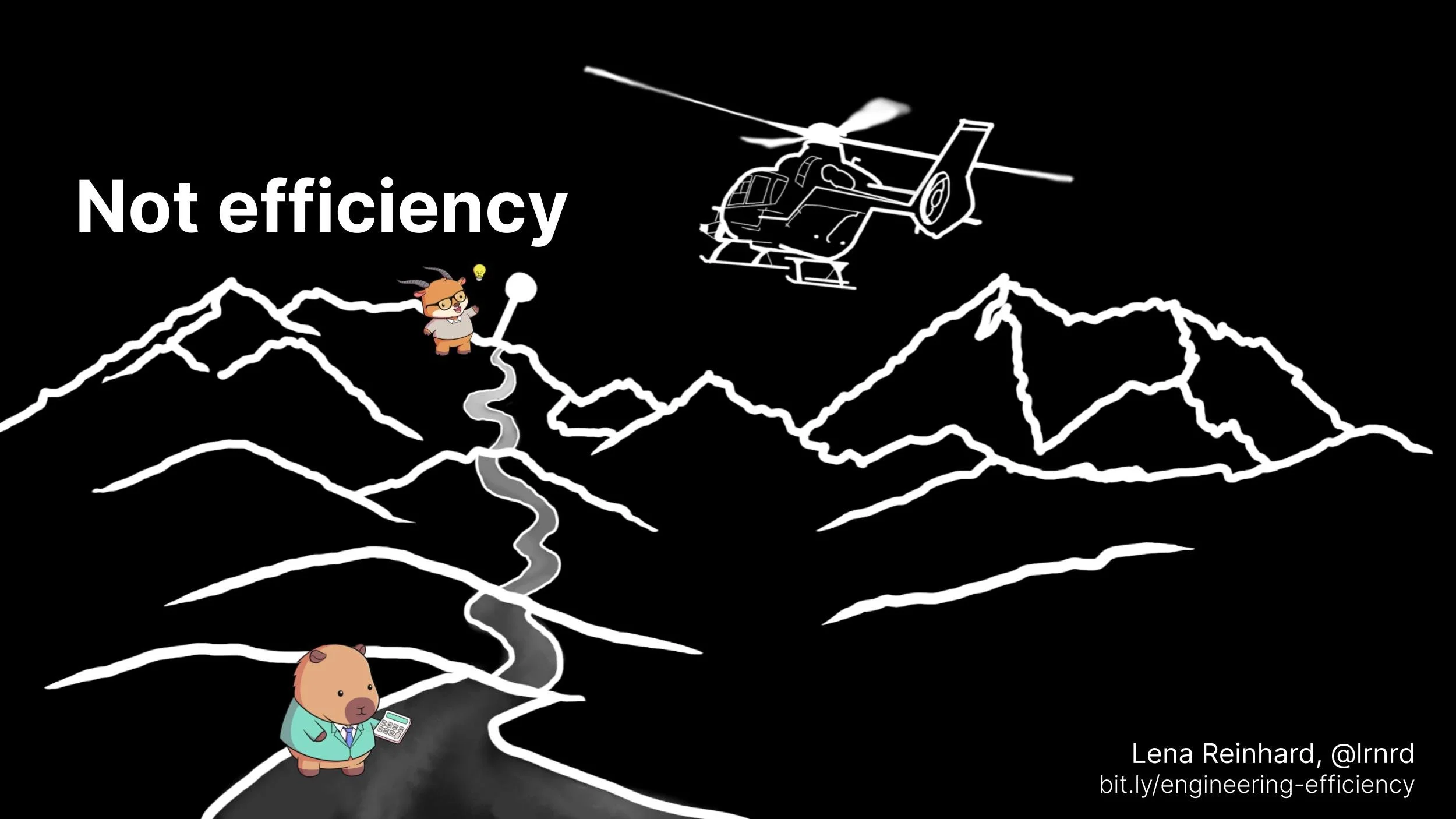
Between effectiveness, efficiency, and productivity, what do companies optimize for?
It depends & may change over time! And neither helicoptering nor walking is inherently good nor bad! Efficiency and effectiveness are a spectrum, with productivity in the middle. Ultimately, achieving their goals is what all companies are trying to do, but on the spectrum between efficiency and effectiveness, tech, especially VC-funded tech, tends to go to extremes.
This can even be a business strategy:
Do the right thing, at a considerable cost, like taking the helicopter up to the mountain top. That’s what many companies have been doing over the last years on a quest to increase market share or break into new markets.
Do the wrong thing, cheap. An example here are growth team experiments: You don’t know if you’re doing the right thing, but don’t spend a lot to find out.
Optimize for a balance of both: Even when an organization pursues productivity, it can still mean to e.g. spend a quarter more focused on higher effectiveness, and another more focused on efficiency; a concrete example from a product company developing a new feature: They strictly define the scope that a feature will have for its release; they know they want it to scale for millions of users longer-term, and design the architecture for this to be feasible, but are intentionally marking some of the scalability work for after the initial release. That’s an example of initially prioritizing effectiveness (“feature is released”), later on efficiency.
Companies choose what to optimize for based on a variety of factors:
External factors: Broader economic situation and outlook, including stock markets, VC market, and interest rates; political situation and outlook; competitive landscape and market share
Internal factors like investor demands, what stage they’re in, their financial situation (funding situation, runway), strategic goals, or lessons learned previously
Short- vs. long-term, like accepting high short-term cost to get long-term savings or gains.
As the ideal state for many software engineering teams is high productivity, i.e. a balance between effectiveness and efficiency, we’ll focus on this aspect in the remainder of this article. If your team/company is more focused on e.g. efficiency, just pick more approaches that help with that.
How to lead productive engineering teams − every day
We’ve looked at the very big picture and at efficiency and effectiveness in the abstract. But now, let’s fast forward to Monday morning at 9am, you open your laptop, you’re ready to lead efficiently and effectively. Now what? Let’s gather everything you will need:
Map: Know your organization
Flashlight: Define metrics
GPS: Know your position
Hiking boots: Make it real
Binoculars: Watch out for condition changes
Plus, always communicate to validate: Share your findings to take others along with you on your hike.
Step 1: Know your organization (and your boss!)
Like anything in leadership, the start is understanding the bigger picture around us: The organization, its goals, and how our teams factor into those.

Ask the following questions:
What are our values or principles? For example: High-performing, long-term stable teams vs. high turnover? Outsourcing vs. in-house software development?
What is our goal? How do we measure success?
What are we optimizing for?
How are we as a team making and costing the business money?
What’s our budget?
Sources to consult:
Speak with your boss
Review documents (strategy, principles, roadmaps, Product North Star, company goals, investor briefs)
Follow industry news
Budget: Ask HR/Finance. If you don’t get a budget, ask for what you can use to estimate the cost per employee hour.
validate!
Share what you find by asking these questions back to your boss and to your team; here’s a great template for pushing information!
This is your map - an understanding of your organization and the broader landscape.
Step 2: Define your metrics

Starting with defining metrics may feel a bit counterintuitive to you, and that’s fair! Defining metrics first will help you make sure you’re on the same page as your boss and know clearly how success will be measured.
That’s where metrics are really helpful: On your map, they help you understand if you’re going in the right direction. Below, you will find some metrics to get you started. I encourage you to only pick 3-4 total to start with; you can always add more later on!
engineering productivity metrics
You’ll measure productivity by selecting a mix of effectiveness and efficiency metrics:
Effectiveness metrics examples
Alignment
Clear goals: Goals are understood by everyone and all move in same direction.
Shared mindset: On the same page about needs, goals, deliverables, timelines, process, and approach.
Evaluation: The team has clarity on how they are being evaluated in terms of projects, annually, as a team, and as individuals. The metrics and KPIs are clear, and the process is largely transparent.
Structure
Strong structure means that processes are clear and information is easy to access.
The skill sets on the team are dispersed and team members know who to contact for various needs
Flow of a week, day, month, and quarter makes sense to team members.
Team has the right context + scope
Everyone is clear what services and business metrics each team owns
Everyone has the “right context”
Supportive context (psychological safety) - supporting each other, no fear of failing
Goal attainment
Are we achieving our goals?
In the quality that we desired?
What do our customers think?
Efficiency metrics examples
Waste-limiting
Deployment frequency (DF)
Focus: disruptions, work in progress (WIP)
Agile metrics: Lead time, cycle time,...
Investment distribution: Cumulative flow
Toil
Culture-building
Visibility: Available metrics, observability
Feedback regularity
Experimentation, learning from failure
Output
Lead time for changes (LT4C)
Planned-to-done ratio
Pull Request (PR) Rate
I have written extensively about software engineering and delivery metrics, find more in the following articles:

Now that you have an idea of some sample metrics, it’s time to select:
How to choose the right metrics for your team
Metrics create incentives.
Incentives create behaviors.
Behaviors create culture.
Choose your metrics carefully.
Metrics create incentives to act a certain way, or to stop doing something.
Incentives create behaviors. This is called Measurement reactivity - when people know they’re being measured on something, it will alter the way they behave - and we can use this to our advantage with our teams, shaping how we act by choosing how we’ll measure ourselves together.
Behaviors create culture. Culture is the behavior we reward and punish. Every piece of feedback we give, every promotion - all creates culture, whether we like it or not.
Apply this to how you choose your metrics:
Measure productivity, i.e., a balance of effectiveness and efficiency metrics. Don’t overindex on only measuring in one of these areas. Even if your company is currently more focused on either efficiency or effectiveness, always capture at least some metrics from the opposite area as well
Mix leading and lagging indicators: We only know whether we’re achieving our goal when we reach it (or don’t), so goal accomplishment is a lagging indicator. On the flip side, deployment frequency is a leading indicator: It shows a trend very quickly. A mix of leading and lagging indicators helps you spot trends early on and adjust accordingly.
Start with what you can know and can impact easily. Begin with what you can measure, and invest in areas that are harder to measure later.
Few, shared, reviewed, and used metrics is better than lots that you don’t use. Metrics are best when your team knows what these metrics are and you use them regularly as a team: Review them in your retrospectives, talk about them, and invest in getting better. That’s when metrics help you impact change.
Avoid incentivizing “wrong” behaviors. When I set metrics, I like to ask my team, “What if someone only did this one thing, and to the extreme?” - to think through what undesired effects a metric may lead to, and how we could balance it with an added metric.

Metrics are signals, not targets. They’re lamps illuminating your path, not the light to move towards.
And, again, communicate:
Hear from your boss and team about your ideas for metrics. What do they think? What feedback do they have for you? And, most of all, how do your teammates want to measure the success of the team?
Step 3: Know your position
Now that you know what matters, it’s time to determine where you’re at:

Run a review of your team
The goal of this exercise is to get a clear sense of what you can do to put your team in the best shape possible and where you can optimize for a sustainable setup.
If you haven’t done this yet in the last weeks, do it now, and then twice a year onwards.
Budget, making and spending money: How exactly does your business make money? Where does it spend a lot of money? How is your team contributing to that spending?
Tech: What do our services cost the business? Consider further cost such as software, tools, and equipment: Where can we cut back spending because we’re not using them? What technical investments can we make to decrease cost? What toil work can we automate?
Delivery: What recurring issues are coming up in our delivery? What areas do we have low visibility into?
Structure, staffing: Is the team staffed appropriately, with the right number of people as well as the right skills and experience levels? Do we have knowledge silos?
Next up, identify improvement opportunities
For each of these areas from budget, tech, to delivery and structure, ask yourself:
Waste: Where are we wasting resources like money, time, focus?
Near-term: How can we increase our impact by doing things better/differently?
Long-term: Which areas can we invest in now to achieve longer-term cost reductions, improvements, and sustainability?
Examples for how to improve engineering productivity
Limit work in progress and stick to your limit: This enhanced will help you get things done, instead of continuing to pile up half-finished work.
Prioritized Backlog: Maintain a well-prioritized backlog. Focus on items that deliver the most value to the customer, ensuring that the team's efforts align with strategic goals and produce tangible outcomes.
Optimize Processes, Workflows: Begin your days/weeks as a team by identifying the most critical tasks and distribute them well to avoid bottlenecks.
Embrace Automation to decrease toil: Automate repetitive tasks where possible. Continuous integration and deployment (CI/CD) pipelines, for example, can significantly reduce manual work and speed up the delivery process.
Regular Code Reviews to distribute knowledge and improve quality: Encourage the team to conduct regular code reviews. This practice ensures code quality, fosters knowledge sharing, and minimizes the time spent on bug fixes later in the development cycle.
As Tiarnán de Burca wrote, “Inefficiency is an opportunity for great engineering work.” So communicate your findings and ideas again to your boss and your team. This is a great opportunity to get feedback: What ideas do they have? Yoru teammates are subject matter experts, use their ideas!
So now that you have a clear set of goals and KPIs, and have identified improvement areas, let’s operationalize it.
Step 4: Make it real, every day

The greatest potential for change lies in doing things a little bit differently today - and repeating that. Look at the spots where you make significant, but most of all small decisions with your team, and make those with efficiency in mind.
Identify when you can lead with Productivity in mind
Look at the interfaces you have with your team - some ideas are:
Daily standup, prioritization, interruptions, and delivery
Weekly KPI review, team development like 1:1s, and delivery rituals like backlog grooming, work breakdown, estimation, and planning

In addition:
Twice per year
Team review
Performance reviews
Regularly-ish
Hiring
Big tech investments
Architecture decisions
Questions to discuss with your team
Talk about effectiveness:
Alignment with strategy: How will this move toward our strategy?
Structure: Does everyone have the appropriate context?
Are we achieving our goal?
In the quality that we desired?
Talk about efficiency:
Waste-limiting: How focused are we?
Culture-building: How well are we learning?
Output: How long do changes take? Are we getting done what we planned?
Step 5: Watch out for changes

Change means that companies also shift what they optimize for. Changes in areas like economic conditions, investor demands, or strategy mean that you have to adapt how to lead your team towards efficiency and effectiveness. This is why it’s so important to zoom out and look at the bigger picture on a regular basis: To stay in the loop and adapt as things shift.
If you’re taking all the steps we’ve walked through so far, it means you’re already regularly talking about all things business with your boss and your team. In addition, make time for strategic and big picture thinking every week. You can find a framework for how to do this big picture thinking and a strategy cheat sheet for download here.
Productivity stands at the core of successful engineering leadership. By fostering a culture that values doing the right things, the right way, leaders can navigate their teams through uncertain times towards sustained success.
Remember, the goal is not to maximize output at the expense of well-being but to create an environment where innovation thrives, and every team member feels empowered to contribute their best.
This article is based on the presentation: Doing the right thing, better: How to lead with efficiency in mind, delivered on 14th March 2023 at Lead Dev New York.