How to overcome change resistance in your organization
“We made all these changes to improve things for our employees, but some of them are not on board at all! How can we convince them?”
“All our longer-tenured employees are against the changes we’re making!”
“People don’t seem to trust the changes that our leadership team has worked so hard to implement.”
Do any of these questions sound familiar? Employees who are hesitant, questioning, or outright against organizational changes is a common issue many leaders face. Many startups and scale ups that I work with handle a lot of change in the first place, often complicated by strong and initially puzzling reactions from employees. Here are concrete steps you can take to address this.
Understand factors that impact our response to change
Our brains are wired to protect us from danger, and any kind of change will be perceived as a threat at first. Several factors, individual and organizational, impact our response to change:
Individual factors
Personality: Choice or control is one of our human core needs: We all want to be able to make decisions about our own lives, including our work lives. The degree to which choice is important to us, and to which our core needs are satisfied, impacts our response to change.
Readiness, tolerance, and desire for change vary greatly, and so do our individual needs and reactions to change.
Motivations: We can be more motivated to support change that aligns with our own values and goals, over change that runs counter to our interests.
Life circumstances: Someone who usually embraces change may suddenly have a much harder time with it when they’re going through personal hardships such as a breakup or family difficulties.
The amount of organizational change we’ve already dealt with can lead to change fatigue in some people and teams, resulting in people who no longer feel in a position to openly absorb further changes.
Individual history: How has this person experienced previous changes, both the change as well as its impact and the outcomes?
Consequences of the change: People typically react less openly or positively to change that they perceive may make things worse for them, the people, and causes they deeply care about.
Organizational factors
History: What’s the organization’s track record with changes so far? How were previous changes handled? What outcome(s) did they produce? Has the organization gained trust in its ability to handle change, or are there deficits?
The nature of the change:
Scale: What’s the scale of it, is it bigger or smaller change?
Values: What values are driving it?
Purpose: What’s the (perceived) goal of the change?
Speed: How fast is the change happening?
Amount: Is it a one-off or serial?
The overall change budget of the organization: Many more traditional change management approaches treat change as an undertaking that’s eventually done. But most modern organizations don’t operate this way: Change and transformations are part of leaders’ daily job. DevOps culture is about embracing small, frequent change, and making it easy and positive for teams. This also means that the total amount of constant change that organizations and all their members deal with are already quite large, and can contribute to change fatigue. Therefore, it’s especially critical for leaders to handle both small and big changes with grace.
Models for human responses to change
One very helpful way to understand the process of change for individuals, as well as groups, is ‘The Kübler-Ross Change Curve’, also known as the transition curve. It is derived from the theory of how people cope with death and bereavement. Elisabeth Kübler-Ross (1969) observed people in the process of coping with death and bereavement. She found that all change, welcome and unwelcome, involves elements of letting go of the past and engaging with a different future.

Kubler-Ross grief curve, change curve. Source: Wikimedia Commons, CC BY-SA 4.0
Change reactions are not linear. People don’t always neatly walk through these stages until they’re “done” processing changes. They may go in circles, go backwards, or skip steps.
Ambiguity is tiring and can make us anxious. In uncertainty, we default to what we are familiar with. Humans operate in patterns and we resort to what we know.
Change response is about individual perception. There is no universal truth, and no “correct” response.
What motivates you doesn’t always motivate others: Your job as a leader is to drive change, so change initiatives and transformations are on your mind and their success is important to you. On the flipside, your teams may not actually care as much - oftentimes they’re only slightly impacted, and the actual focus of their daily work is on getting their own job done. This also means that they likely don’t see or understand what you’re trying to do.
Understand differences in contexts: As a leader trying to make changes, you likely have context that your teammates don’t have. You understand the reasoning, have weighed different options, and made informed decisions. They likely have none of this context.
Your teammates operate on a different time scale than you do. You’ve likely spent weeks or months thinking through these changes, while your teammates have been busy coding, designing, or doing other work. You’ve thought about this for a long time, while they just heard about it a few minutes ago. What’s old news to you is entirely new to them, and where you’ve already got momentum and are ready to move on, and do so quickly, they’re just catching on.
Remember that you’re looking at this change from a different altitude. Higher-level leaders and executives are especially likely to struggle with this. Their view of the organization is from a very high level. Reducing the level of nuance and complexity that they deal with allows them to operate effectively as executives. But individual change responses bring a high degree of nuance and complexity with them, and often make what seems like a simple initiative may all of a sudden be very complicated.
Your intentions for a change may be positive, but not everyone will see it this way. I’ve been part of many organizations that tried to, e.g., introduce new goal setting that would involve all teammates more, or run an initiative that was intended to be for the good of employees. In cases like this, managers are often surprised when not everyone is on board or some people outright disagree with the change. “But this is good for everyone!” - What you think is good for others won’t necessarily be what they think is good for them, at least at first.
Change is a major clash of different perceptions, values, and individual motivations. What you don’t find important in a change will be a critical issue for others. You will likely be confused sometimes as to why others don’t see things the way you do. In my experience, this difference in viewpoints is one of the most common sources of tension and frustration in all kinds of change management.
Eight steps for dealing with change resistance
So how do you deal with resistance to change? Many leaders feel the impulse to move into “sales pitch” mode and convince people that the change is, in fact, a good thing for them. But a sales pitch is a solution - as always, take a few steps back and make sure you understand the problem first!
1. Reframe what’s going on: People don’t resist, they respond
You may perceive their response as resistance, but, by framing their hesitation, questions, concerns, and reactions as “change resistance”, you’re already creating a narrative of “us vs. them” and getting your guard up, which will make it harder for you to deal with their reactions in a productive way.
2. Understand your own reaction
If people’s reactions to change are frustrating or puzzling to you, try not to get your defences up or move into sales mode. Instead, reflect on your own perspective and reaction. Remember that your perspective on the changes likely differs from your teammates’. Ask yourself:
What am I missing?
Where do I have blind spots that make me overlook aspects that are important to others?
What’s irritating to me about their reactions?
Where is my frustration coming from?
Understanding your own responses allows you to operate from a place of calm and generate productive thoughts and feelings.
3. Get curious!
Embrace the variety, complexity, and nuance of change reactions. Lean into a mindset of genuinely trying to understand.
4. Listen and open a dialogue
Change is about perception and values. What you think remains the same, other people may see as changed and important. Approach your teammates and let them know that you’re interested in hearing their thoughts. Bring empathy and an appreciation for differing perspectives as you ask open questions:
How do they feel about the change?
What questions do they have?
What concerns do they have? Where are those coming from?
What are their reasons for hesitating?
What feedback do they have for you about the change? And what about the way you handled the change?
Let them know what you plan to do about their feedback, e.g. think about it, and include it in a feedback overview for the leadership team.
5. Act on people’s feedback
Acting on employee feedback doesn’t mean you have to implement everything that was suggested. Acting only means closing the feedback loop:
Express gratitude. Accept all feedback with grace and without arguing, minimising, or getting defensive.
Action: Decide on your course of action.
Close the feedback loop:
Connect back with the feedback giver.
Explain what you have decided.
Share your decision-making process
That’s it. The crucial part is closing the loop: Getting back to the people who shared feedback and letting them know what you decided to (not) do about it is the part that builds trust. People don’t typically expect that everything they’re suggesting will be implemented, but they want to know that you heard them and took their concerns seriously.
More about reacting to feedback as a manager in this extensive guide (PDF download link).
6. Acknowledge what’s been lost
William Bridges’ transition model can be useful in addressing the psychological impact of change. The idea here is to move with employees through three stages: From “endings”, through a “neutral zone” between old and new, to “new beginnings”. When announcing changes, many leaders tend to move immediately and excitedly to “new beginnings”, where they try to convince everyone of the new state. While well-intended, this often makes people feel unseen and like their concerns aren’t addressed. Instead, acknowledge what people are losing with genuine empathy, don’t dismiss it as trivial. You can still do this retroactively!
This is a great guide to using the Bridges Transition Model in practice for planning and conversations about change.
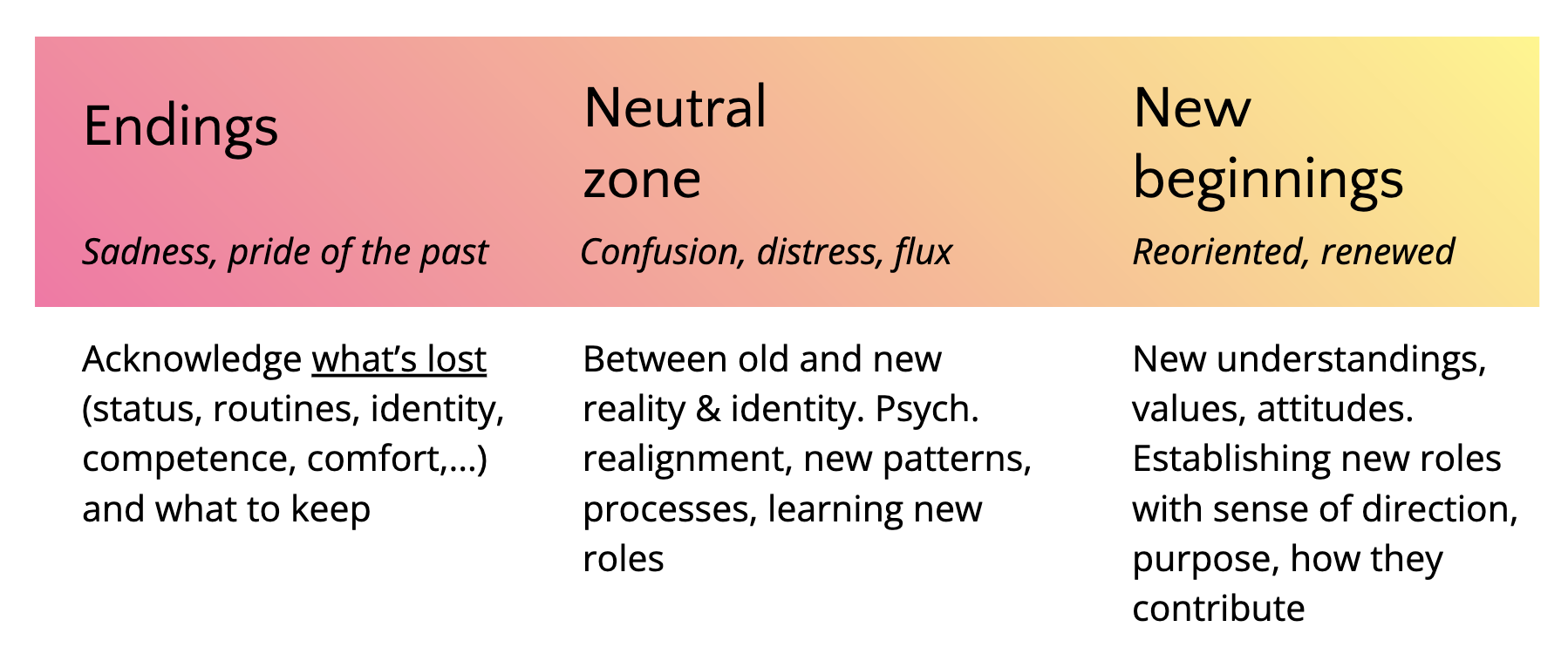
Bridges Transition Model, adapted from William Bridges
One example: In fast-growing startups, reporting structures and hierarchies tend to change quickly. A while back, I spoke with an employee who used to report directly to the CTO when the company was still small. But now, they were reporting to an engineering manager who was four levels below the CTO in the new hierarchy. And while they liked their new manager, they also felt like they didn’t have as much impact as they used to, and had lost direct access to the CTO. We ended up talking about their ambiguities regarding the change, and worked out ways for them to increase their impact again, and get them better access to higher-level contexts that were relevant to their role.
7. Engage people in refining the changes
Involve your employees in refining the changes you rolled out. Some approaches that I’ve found useful are:
Increasing transparency by sharing back. Gather feedback and present it to your teams, e.g. in an all hands meeting. Thank everyone who shared their thoughts. Include what you’re doing about the feedback. This signals that you’re hearing concerns and that you’re open to them.
Delegating work on refinements to the groups that are most impacted. You may need to set some direction first, e.g., by letting people know what you will and won’t be able to change. Then let people collaborate on improvements.
8. Do better next time
In my work managing teams of only a handful to several hundreds of employees, here are some things I’ve found helpful for preparing changes:
Delegate as much change as possible to the people who will be most impacted. Give some direction and guidance, then hand ownership of making improvements to their areas to teams or sets of teams (domains). This will not only get you much more buy-in, but also usually lead to much better results because people understand their own needs best.
That’s not always possible, so if there are larger changes that you absolutely have to own, here are some tips for more transformational and inclusive approaches:
Get your leadership team on board. If at all possible, involve your leadership team in preparing the change. This will help in getting good information upfront and testing the waters, but also later on as change reactions come in. Even if that’s not possible due to a high degree of confidentiality, you can work through the aspects below by yourself or with others who are in the know.
Get intel on what to expect. I’d often ask my management team, as well as employees I had strong relationships with and people who are well-connected in the organization:
How did they expect people to react to a certain change?
What could we do to get people’s buy-in?
Gather expected reactions with your leadership team. The range is typically wide, from excitement to hesitation or “resistance”. When you already have a sense of what people may say, you can prepare.
Address expected questions and reactions upfront, e.g. in an FAQ document that you share with the change announcement. Not only does this help employees find relevant information, it also shows that you’ve considered their viewpoints.
Set up open channels for feedback and questions and respond effectively. You don’t have to take action on everything that people suggest, but you need to make sure to close the loop with them. LINK
Change responses aren’t linear, but they’re manageable!
If you work in a high-change organization and want to learn better tools, techniques, and improve your confidence, sign up for my workshop “Becoming a successful change leader”! The next dates are October 25 in San Francisco and November 2 in Berlin, and we’ll have a ton of takeaways for you that you can immediately apply in your role, no matter how high- or low-level it is. Or, maybe you’ve already made changes and are now dealing with puzzling reactions - contact me, I’d be happy to support you on this.
And remember: Change responses come in all shapes and sizes, and they rarely follow textbook-style patterns precisely. This means that you may have to take some of the steps described here backwards, or repeat some of them. And that’s okay! If you listen closely and close the feedback loop, you will always come out on the other side with more lessons learned and insight gained.