Leadership Ideals In Tech And Their Real Consequences: The Dark Side of “Driving Innovation”, “Getting Things Done”, And “Being Authentic”
In this article, I explore three leadership traits that are often deemed crucial for leaders in tech: Driving innovation, getting things done, and being authentic.
I examine each of those and show how they’ve been used to gloss over problematic consequences and have contributed to herd mentality and hype culture, cultivated a hustle culture of overloaded roles and responsibilities, and grew a hush culture that neglects to take seriously the experiences of women, queer people, people of color, and other underrepresented groups in management and leadership roles.
I also give many practical tips for leaders dealing with these issues, and encourage leaders to reflect on their impact and to lead with integrity and responsibility.
This article is a summarised version of my talk “What we talk about when we talk about leadership”, presented at LeadDev Berlin in November 2024 and in an earlier version at LeadDev London in June 2024.
What do you think makes a good leader?
What do you think makes a good leader? — You may have thought of things like Goal-orientation, innovation, getting things done, driving impact, providing direction & vision/strategy, high degree of ownership, decision-making, great communication, grows talent, authenticity, introspection, or something else. But maybe the even more important question is, what do you think makes you a good leader?
What do you think makes you a good leader?
It could be that you think living up to your values and leading up to your values makes you a good leader. Or that the business needs and the work are aligned with what you value; or it's about what your boss thinks of you and how they perceive your work, or what your employees want and wish. Or it’s the results that you get, or of course, how you got those results. Now, is a good leader at the intersection of all of those?

Venn diagram depicting different but overlapping facets of what constitues a good leader
There are course negotiations taking place between those different facets, and they're a part of navigating our daily lives as leaders. And oftentimes, and maybe ideally, this negotiation is much less noticeable or explicit because all of those things pretty much align. And if you're in a position like that, that can be really great. But what when those things aren't as aligned anymore? I've been in such situations and I frequently also work with leaders who wonder how long they can still stay in a job that was increasingly demanding things of them that were not aligned with their values.

Venn diagram depicting different and less overlapping facets of what constitues a good leader
These kinds of questions don't get easier by most of us having to do things like pay rent and buy food for ourselves and our families. And when that happens, that kind of misalignment, how do our ideas and ideals of leadership really hold up in reality?
So today I want to explore three ideas of leadership with you and talk about what we talk about when we talk about leadership.
Leadership Idea #1: “Leaders Innovate”
The first idea of leadership I want to discuss is innovation. It's a big part of lot of leadership conversations and I want to begin with one that we've been talking about a lot:
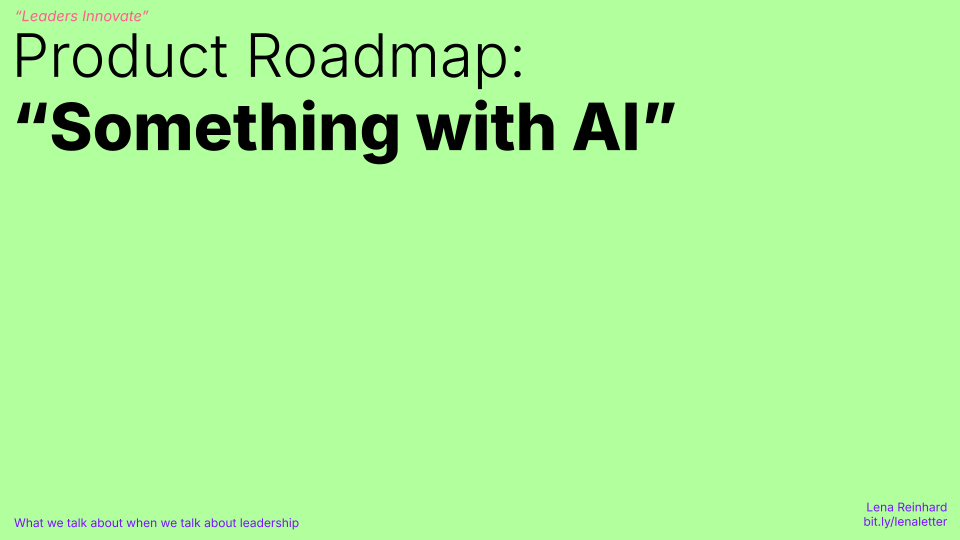
Mock Product Roadmap that says “Something with AI”
This is something I've literally seen on roadmaps, and too many times. And some of you may have too, given the reactions I'm hearing right now. And for anyone who's been in tech for more than, a year or two, this may sound familiar. We had “something with AI”, then “with VR”, NFTs, machine learning, the blockchain, social media, and so on. The tech industry prides itself on innovation, and that’s fun and exciting and an interesting part of our work. But too often, it also means that we all follow the same hype, trends, and patterns, and often go into extremes. The herd mentality in our industry is really, really strong because the concern about missing out on the next big thing is very real.
And for one or two companies, it tends to be actual innovation, but for the rest, it very quickly becomes herd mentality.
And I get it. I've seen this many times:
It’s the next big thing, says your boss
And TechCrunch
You hear it’s where all VC is going now
Your customers will ask for it any day now
And your investors
And your board
You open Hacker News: “It’s too late for anyone who’s not on it already”
Your competition is certainly on it
Your employees will ask about it any minute
And so will you Product team
You will surely need it to raise more money
Every conference has sessions about it
And while you wasted spent time thinking about it, your competitor posted on LinkedIn that they’re working on it
And what’s that Slack notification you’re getting? — It’s your boss, asking when you’ll ship it
Casey Newton, a technology journalist, recently described this kind of dynamic really well on the Search Engine podcast in an episode about OpenAI. He said,
“Sam [Altman] got spooked that his rival Anthropic… was going to release their product [Claude] first and might steal all of their thunder. And so they released ChatGPT to get out in front of Claude. And that was essentially the starting gun that launched the entire AI race.
I think it is fundamental to how Sam sees the world, that all of this stuff is inevitable. And if it's going to happen anyway, all other things being equal, you would rather be the person who did it, right? And get the credit and the glory and the users and the revenue. …
AI developers might care about safety, but in the rush to be first in the field, the company who wins could actually be the company who cares about safety the least.”
And this race has come with a hefty price tag. This is just a very small list of issues with companies running this type of hype race:
2014 Apple Health: No Menstruation tracking
2015 Google Photos labels Black people “Gorillas”
2016 Smart home devices incl. cameras stream home content publicly
2016 Microsoft’s AI chatbot Tay takes on racist, sexist, homophobic personality, denies holocaust
2016 Google’s speech recognition software struggles to understand women
2017 Facebook algorithms substantially contribute to ethnic cleansing in Myanmar
2017 Snapchat identified as pedophiles’ go-to sexual exploitation tool
2017 FaceApp “hotness” filter pushes racist beauty standards. CEO: “Unfortunate side-effect caused by training set bias.”
2017 Trans YouTubers’ videos used to train facial recognition software without their consent
2019 Self-driving cars fail to detect people with dark skin
2020 Lawsuit: Apple Watch’s blood oxygen sensor racially biased against black people
2022 Meta’s scientific research chatbot Galactica makes things up
2022 ChatGPT released with hallucinations, biases; copyright questions
2023 Microsoft’s new chatbot in Bing would like to be human, wants to destroy, in love with user
2023 Google & Apple Photo Apps still can’t find gorillas; label label shut down
2024 Google Gemini creates lethal food recipe
2024 Snap dismisses employee concerns over 10,000+ monthly reports of sextortion: “Addressing child grooming would create privacy issues and be too expensive.”
2024 50+ Roblox group chats with solicitation of child sexual exploitation content. CEO: Roblox platform is "a beacon for safety and civility."

Positive outcomes from generative AI adoption. Source: Scale.ai, AI Readiness Report, April 2024, N=1,800
Meanwhile, in April 2024, the AI company Scale.ai published an AI readiness report where 62 % of companies reported increased process efficiency internally and only 8 % had seen failed AI projects. — How? Like I can't get ChatGPT to write a career and an accurate summary of a blog post that I wrote myself to cross post on LinkedIn. And you're telling me that 34 % of executive teams are using it to assist their strategic decision making? How bad have things been on your executive teams before?
And in an earnings call in October 2024, Google CEO Sunder Pichai claimed that Google now 25 % of code is AI generated and then reviewed and accepted by developers. So do we think that Google has previously already tracked how often its users use code completion or code snippets pre-AI? Or are we talking just 25 % of boilerplate code? Or 25 % of business logic That's the same company whose AI also just created a lethal garlic oil brew recipe for a human feed to feed their family with. Based on what we know right now, this number is probably much more in the boilerplate direction, which will save engineers some time, but the number is also not as impressive in terms of savings as it initially suggests.
But the much more important reason I wanted to share this Pichai quote here is that Google has already bet a ton on AI. And if these things happened like they often do, they probably told all their engineers a while ago to use AI assistance for programming and told all managers to make sure that's happening. And at least those managers' bonus will probably depend on that happening. So of course, everyone at Google now tells their CEO that, of course we use a ton of AI to produce our code, because he told them that that's what he wanted to hear.
The “25 %” piece of information is useless to tell us anything about the quality of AI completion tools or their impact on efficiency or productivity. But it makes for really good PR and messaging to investors. And that's how that hype cycle continues.
Nikhil Suresh, an executive director with a background in data science, wrote in June 2024:
“There are those that have drunk the kool-aid.
There are those that have not.
And then there are those that are trying to mix up as much kool-aid as possible.
I shall let you decide who sits in which basket.”
The consequences of these hypes continue
These consequences of these hypes continue:
Data centers alone are already consuming the equivalent of a top-10-energy-consuming country.
The greenhouse gas (GHG) emissions of Bitcoin mining alone could be sufficient to push global warming beyond the Paris Agreement's goal of holding anthropogenic climate warming below 2°C.
AI is accelerating climate change: From 2024-2029. the datacenter industry is set to emit 2.5 billion tonnes of GHG emissions worldwide, 3x more than if Generative AI had not been developed.
Driven by fear of missing out, tech companies frantically race after the next thing and the next thing and the next thing and the next thing. And meanwhile, the cost of our decisions is already being paid, just largely not by us. But temperatures have been rising in Western Europe too. We aren't shielded from this forever just because we're in the privileged West. Because the consequences aren't over as limitless pursuit of shareholder value is burning up the planet with devastating impact on humans across the globe.

When it’s leadership, it’s not called “carelessness”, it’s called
“Don’t bring me problems, bring solutions”
“Bias to action”
“Sense of urgency”
“Disagree and commit”
“Move fast and break things”
“Better beg for forgiveness, than ask for permission”
And even if we don't work for Google, AI, or Meta, or many of the other big companies I've just mentioned, we play a role in this:
A few months ago, I worked on the engineering leadership report, a survey I created together with Lead Dev. And one of the questions that we asked technical leaders in there was, “what are your biggest concerns about generative AI?” We got a lot of answers along the lines of “management will overly rely on the hype.” — Who's management?
I often get questions about how to become an engineering director or VP or a CTO one day. And that's a really great question to talk about. But one day, many of you will be in those positions. We are “management.” And even if we don't work for any of those big companies, the choices that we make every day with our teams have enormous impact.
What does that mean for you?
So what does that mean for you and me and us? This is the first recommendation I'm going to give you for today:
Combatting Hype Culture: Lead Through, Not With, The Hype
Lead through and not with the hype. Don't take all headlines that you see at face value. Instead,
Get to the core of it. Ask questions likie:
“What business/user problem are we trying to solve?”
“How short-term vs. long-term viable is this?”
“What are privacy, security, societal issues associated with it?”
“How will we mitigate the risks?”
“How much $€ is this worth to explore?”
Do good, boring engineering work; monitor and contain your costs. It’s shockingly useful! It can have quite great impact, not just on the metrics of your business, but also on the environment.
Invest in your operations and culture, and build teams and businesses that are not for fast and global scale.
Choose who you work for, hold companies accountable
Build things & businesses not for fast returns and global scale
Hold yourself accountable
This was leadership idea #1: Leaders Innovate, and how it often instead results in hype culture, its consequences, and how to lead through the hype, not with it.
Leadership Idea #2: Leaders Get Stuff Done
The herd mentality that I've mentioned earlier also applies to the layoffs that we've seen in tech. If you look for reasons, that's a quote from Jeff Shulman, professor, Foster School of Business, University of Washington, who has extensively studied the impact of layoffs on workforce productivity:
“There is a herding effect in tech. If you look for reasons for why companies do layoffs, the reason is that everybody else is doing it.
I’ve had people say to me that they know layoffs are harmful to company well-being, let alone the well-being of employees, and don’t accomplish much, but everybody is doing layoffs and their board is asking why they aren’t doing layoffs also.”
If you look for reasons for why companies do layoffs, the reason is that everybody else is doing them. The recent years of layoffs have had massive consequences for employees who are struggling to still find jobs, but also for many leads. 63 % of engineering leaders are are juggling increasingly broad roles and responsibilities, like filling informal positions at once in teams that are bigger than before or dealing with complete chaos. And the hype cycle happens here too. Just recently, a VP engineering at a scale-up told me, “It seems like everyone is having engineering managers code again, so I'll do the same.”
Getting stuff done with vaguely defined roles, and even more responsibilities
Engineering leadership roles have for a long time already been poorly defined, but are now often even more chaotic, with leaders being responsible for people management, including mentoring development, but also technical leadership, strategy and decisions, delivery management with product and project management, and some hands-on coding.

We have a word for this in German, and I promise it's not an insult. The German word is Eierlegende Wollmilchsau. It's an idiom and usually used as a joke and describes the ideal of an imaginary hybrid livestock that combines the advantages of different types of animals. We can also use it to describe a person, a solution to a problem. And it seems to only have advantages, satisfy all needs, and of course, therefore, is not real.

So these kinds of broad roles are real, but they're incredibly difficult to do well in at all times without burning yourself out or your team as well in the process. And that puts even more pressure on the people in those roles.
Tips for dealing with very broad roles and vastly increased responsibilities
Tip 1: Tackle ambiguity for you & your team with Hyper-visibility
This ambiguity that you and your teams are dealing with right now, push through it with as much visibility as you can:
Get good at managing up & alignment: Be hyper-clear about priorities, incl. what you’re not doing bit.ly/manage-your-manager
Document your work & impact, share it with your boss. Good work will not always just be seen. Don't believe that old narrative.
Grow your community.
Get creative at finding/creating growth opportunities (those may be less exciting than before)
Tip 2: Share what you can to support your local community
I also want to look a little bit outside of tech because many of us are still in very fortunate circumstances, even though the work in the industry has become much more tricky for many of us. So if you can and have the resources, share some of your skills, your money, your time or energy, like:
Become a mentor or sponsor; pass on your experience
Neighborhood cleanup
Join your local library
Share tools with neighbours
Make art
Support local, independent journalism
This was leadership idea #2: Leaders Get It Done, and how this mantra has resulted in too-broad roles that are impossible to do sustainably, and how to handle such roles.
Leadership Idea #3: “Leaders Are Authentic”
“Authenticity” is one of the ideas people often associate with modern leadership ideals. This idea of authenticity has definitely become overused, especially in the modern age of social media, but it sticks in the workplace. But what does it really mean to be “authentic” as a leader, and who is that concept for?
56% of women leave the tech industry 10-20 years into their careers (2x the rate of men).
50% of women in tech leadership roles leave them by age 35.
From 1984-2023, the number of women tech leaders went from 35% to 28%.
21% more women than men in tech leadership roles feel burnt out.
From 2005-2024, the number of women in tech went from 22% to 22.6%.
An estimated 45% of those laid off in the 2021-2023 layoffs were women, disproportionate to the percentage of women in the tech workforce in the first place.
I'm over 35. I've been in tech for over 15 years, and my career spans over 20 years. Statistically, with every day that passes, it's increasingly unlikely that I'm still here.
I talked about all of this with a former boss of mine a while ago. And what he said in response was this:
“So, throughout your entire 15-year tech career, you’ve always been concerned that you might experience discrimination one day?”
I've been able to work on fundamentally fantastic projects and really impactful technology with people in this time. I've had wonderful coworkers and teammates. We've built great things together for hundreds of thousands of users. I've been able to travel the world, make good friends.
But at the same time, almost from day one, this statistic of being discriminated against at work was never a hypothetical: I was sexually harassed by my startup's most important client. I was the target of online organized harassment campaigns after giving talks about diversity and inclusion in tech. I was bullied by employees and senior leaders in companies that had a really strong public image of valuing diversity and inclusion as the only woman leader there. I was told more than once that I shouldn't talk about those things in public because it would be a career killer and no one would take me seriously anymore. And I do want to say that's just an excerpt, but compared to many others, many women, people of color, queer people in leadership roles have experienced, I've been very lucky and fortunate and privileged regardless of that.
While we all talk about the latest hype, many women, people of color, queer and disabled leaders also talk about things like:
But none of this was ever hypothetical. While we all talk about the latest hype, many women, people of color, queer and disabled leaders also talk about things like:
Team members ignoring them, speaking over them, and how to handle it without being labeled as “bossy”
After returning from parental leave, getting fewer opportunities than peers
When keeping everyone from talking over each other in meetings, being called “intimidating”
Being the expected coffee maker
Being told they’re “not technical enough”, despite their engineering degree
Being pushed into management as they’re “good with people”, despite wanting to remain technical leads
Whether to attend the next company offsite after repeated unwanted touching at previous events
How much to advocate for better culture without being told they’re “difficult”
Being told they’re “abrasive”, “confrontational”, “loud and dismissive”, “not collaborative” when sharing a differing view
Being called “bitchy” after calling out they’ve been talked over
Being told to smile more by senior leaders
Being labeled as “aggressive” or “out of line” for showing ambition or asking for a raise
Being discriminated against at a company that has a strong public image of being “inclusive”, and what to do when they’re asked about what it’s like to work there
How to deal with more likely being promoted during crisis or downturn when the risk of failure is highest (“glass cliff”)
Being told they’re not “passionate” enough because they don’t have time for side projects
How much do I push for a company to do better, until I’m at risk of losing my job?
How can I still “lead” at my company, when the same company has turned against me?
VCs and founders who aren’t safe to work withHow long they can hold out in this role, despite the toll it’s taking on them, because they need the money and
to protect their team from discriminatory senior leaders
because many hiring managers immediately disqualify short tenure, and how do you talk about discrimination in your resume?!
because they don’t feel they can fail, as the only woman/Person of Colour/… in this role
“at least here I know what I’m dealing with, it’s not much better elsewhere anyway.”
These topics are new for tech overall and I know that many of you have heard about them. And yet, there seems to be an assumption that issues like racism, sexism, and other forms of discrimination only apply to employees and just disappear when someone steps into a leadership role. If I look at leadership publications, it's the same deal there, it’s like those issues don’t exist. Looking at ink.com, Howard Business Review, or even leaddev.com or other management publications, let alone popular management and leadership newsletters: There's nothing.
I've spoken about this to hundreds of people in my career, and there's usually just one group of people who are surprised that those issues exist: People who aren't personally impacted by them.
So what, again, makes a good leader? And how are you supposed to be authentic as a leader when your sheer presence, the essence of who you are is making people question your abilities?
“Authenticity” is a concept for cis white men
That's a question that so many people in leadership have to wrestle with on a daily basis. And people of color, queer, trans leaders, disabled leaders, and women in leadership positions are just some of those groups. Authenticity is a concept for cis white men.
Leadership can be lonely, but it’s lonelier for some of us
Leadership can be a really lonely job. It can be complicated and can be stressful. But for some of us, it's lonelier, it's more complicated and also more stressful because we aren't as accepted as who we are. As much as leadership is being talked about, this whole part is eerily quiet. Out of fear of retaliation, being considered “difficult” or unemployable, people don't speak up. This too is part of the leadership experience and we need to talk about it more.
But speaking about these issues has already cost too many people their careers in tech. And I can't even responsibly recommend to any individual to talk about this on the record with their name attached, unless they're done with their career anyway.
So I want to leave two sets of recommendations here:
Recommendation: If you’re experiencing discrimination, don’t go it alone
The first part is if you're a person dealing with some of those things, don't go it alone:
Know that you’re not alone
Know the history of tech
Document your experiences: Dates, names, witnesses. Even if you never use it, have it.
Consult a lawyer (I’m not one)
Grow your community. Unfortunately, there are many others dealing with these issues.
If at all possible: Don’t sacrifice your mental or physical health for a job. Organizations are built to do well without you. You’re not.
Recommendation: Support your peers if you can
If you're not personally experiencing those things, and if you can, even small things can support the people who may:
Volunteer to take notes in meetings. Don't just let the woman in your leadership group always be the one who doesn't.
Volunteer to take notes
Learn about what it’s like to work in tech leadership for someone who doesn’t look like you (look up “being x in tech”, allyship actions; see also my Leadership Confidential Podcast episode on being an ally as a senior engineer)
Don’t let the women & People of Colour on your team be the only ones talking about safety, ethics, culture, equity, and policy
Check in with your peers, ask what they need
Talk pay: There's still a significant pay gap between specifically white men and many other groups in leadership. Sharing what you make helps.
Start/support a workers’ council/union (“Betriebsrat”)
Believe people over your own experience. Just because someone is nice to you, unfortunately, it doesn't mean that they're not terrible to others.
This was leadership idea #3: Leaders Are Authentic, and how authenticity isn’t attainable for many of us who don’t fit dated ideas of leadership, and has contributed to a hush culture where discrimination happens to many of us on a daily basis, but can’t be openly spoken about.
In this series, we looked at three widespread ideas and ideals around leadership and their effects in practice:
Leaders innovate, leaders get it done, and leaders are authentic. The result: Hype culture, hustle culture, and hush culture.
These are key parts of the daily leadership experience that we don't talk about enough. And I do want to emphasize, because I've given a lot of things that you can do as an individual as recommendations, but this is also important:
These issues are systemic and they're beyond any Individual
VC money and hockey stick growth curves, the herd mentality and unfortunately, as we already know, capitalism are all huge drivers in this. The more companies are pushing for fast growth and profits, and the more investors want quick returns, the harder it becomes to create an environment that is survivable to humans, no matter how much any of us individually care about people.
As engineering leaders in these environments, we face increasingly complex questions with no simple answers. And at the same time, I know that many of you deeply care about the people you work with and about the future of our planet. And yes, it's also understandable to feel powerless among all of the changes in our industry in the last years. And that's why amid all of those big changes in our industry, I want to remind you and me and all of us:
The tech industry isn't just some external force of nature
The tech industry isn't just some external force of nature. Many of us are in positions of power, and many of you are the engineering executives, founders, or CEOs in the future. Every one of us is a part of this industry. Every one of us is the tech industry. And every one of us shapes what good engineering looks like.
So I want to ask you again, what do you think makes a good leader?
What do you think makes you a good leader?
There are three things I want you to take away from this:
What impact do you want to have, not just on your teams, but also on the small and big world around you?
Use your brain and heart. Leave the herd mentality to the elephants.
And part three, remember, the Eierlegende Wollmilchsau is not real.