Practical Guides for leaders at all levels
Podcast episodes & articles!
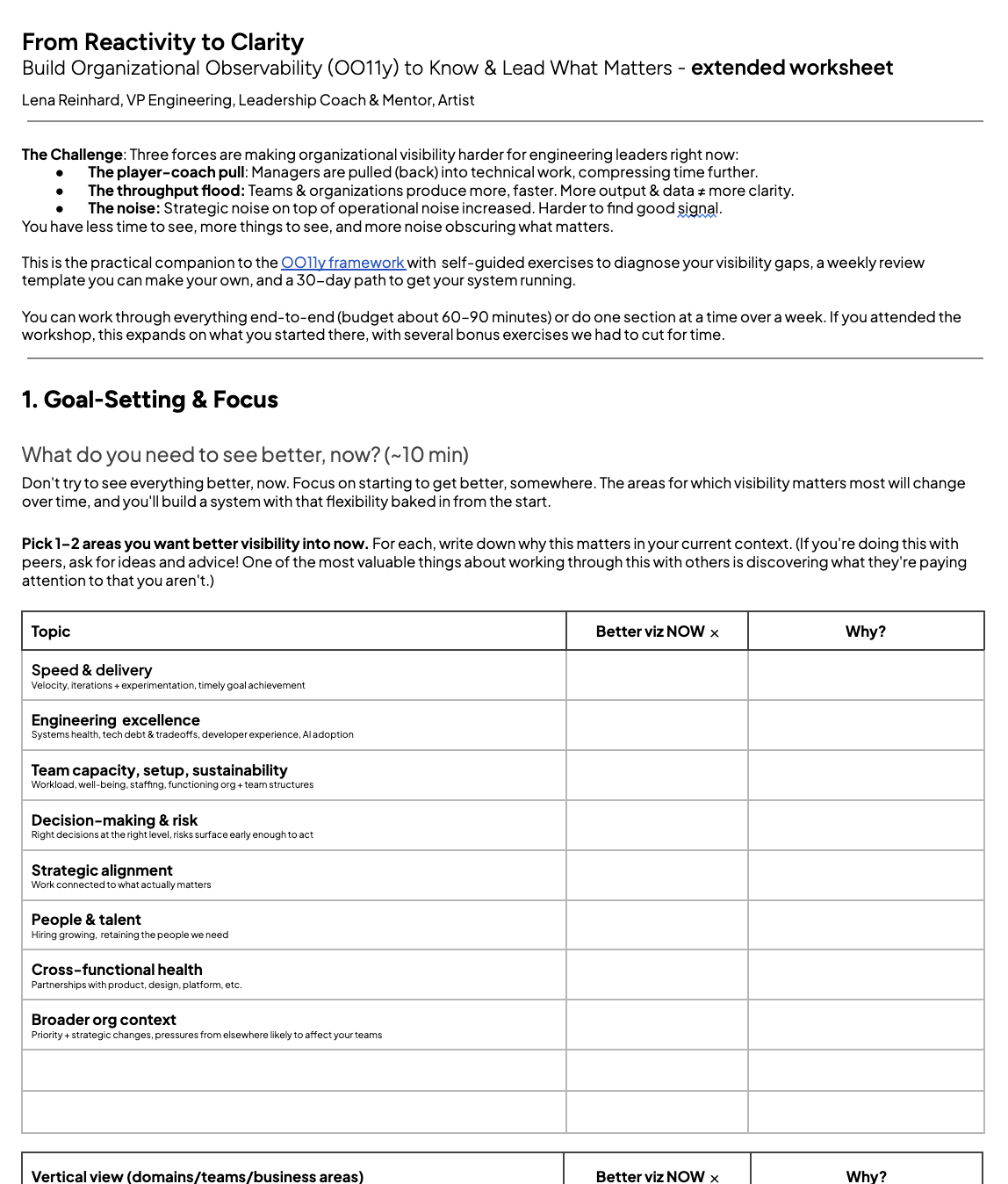
Building Your Organizational Observability (OO11y) System: Exercises, Templates, and Your First 30 Days
You know that you need better visibility into your organization. Now it's time to build the system to make it real. This extended worksheet walks you through self-guided exercises to map your Signals, Conversations & Chats, and Judgment, identify your biggest visibility gaps, and design a weekly review practice you can start this week. Includes a 30-day implementation path, bonus deep-dives on signal integrity and triangulation, a bank of generative questions to replace status-update conversations, and a downloadable PDF worksheet. Start fixing your visibility problems now, not next quarter.

Leadership Ideals In Tech And Their Real Consequences: The Dark Side of “Driving Innovation”, “Getting Things Done”, And “Being Authentic”
I explore the three leadership traits that are often deemed crucial for leaders in tech: Driving innovation, getting things done, and being authentic. I examine each of those and show how they’ve been used to gloss over problematic consequences for individuals, our industry, and beyond. I also share many practical tips for leaders dealing with these issues.

Crafting a Standout Leadership CV: A Comprehensive Guide
Managing your CV is one of the most powerful skill sets that any job seeker can develop. It's also an often-overlooked skill, but can make a huge difference in how you experience your job search and how your professional background is perceived by potential employers. Whether you're just starting your career or you're a seasoned leader, this guide is designed to help you navigate the CV creation process in a way that benefits both parties.

What should engineering manager & Leadership roles look like in 2024?
What should engineering leadership roles in tech look like? We delve into the intense, decades-long debates, and look at how current industry changes affect responsibilities. Learn the crucial skills for effective leadership, and what people and technical leadership roles are right for your company.

Skip-Level Meetings: Common Pitfalls And How to Avoid Them
Skip-level meetings can be a a catalyst for positive change within your organization, but too often, common interpersonal dynamics get in the way of leaders and employees making the most of them. Learn what these common challenges are and how to address them, to unlock greater team alignment and make your skip-level one-to-ones useful for leaders and employees alike.

Effective Skip-Level Meetings: A Guide and Templates for Managers of Managers
Skip-level meetings offer direct communication between senior leaders and employees who report to middle managers. While they can be powerful tools for alignment and building trust, they can be awkward or ineffective if not conducted thoughtfully. This article offers a practical guide and templates for managers of managers to make these meetings beneficial for all involved.

Communicating Difficult Decisions: A Guide For Engineering Leaders with Q&A
Do you want to handle difficult conversations better? Are you clashing with higher-ups who can’t seem to get on the same page? Is your team not receptive to change? Here are questions from leaders and my answers for when you have to communicate a decision you disagree with.

Feeling Overwhelmed as an Engineering Leader: Causes and How to Cope
Overwhelm is common among engineering leaders, but we don’t talk about it much. In this article, you’ll find common sources of overwhelm to help you recognize it in yourself, or support peers, and strategies from my work with many leaders dealing with this that can help you cope and get better.

Recovering From Difficult Change: How to Empower Your Teams to Find Agency and Thrive
This article 3-step guide will help you support your teams in recovering from difficult organizational changes. It shows how to shift from control to empowerment, involve your leadership teams, and how to show up as a leader for your teams. This guide will help you foster a culture of empowerment to drive innovation and success during difficult transitions.

The Case Against “Motivational Leadership”: What Your Teams Need From You After Difficult Changes
Strategies for leaders guiding teams after tough changes like layoffs and reorganizations. We contrast high-control and high-empowerment approaches, and why you should resist the temptation of focusing on motivating your employees to process the change as quickly as possible, and what to do instead.

The Executive's Guide to Maximizing Middle Manager Potential
Your middle managers are more than just intermediaries between your leadership team and employees on the ground. Learn how to equip them with the context, ownership, and clarity they need, and you will not only empower them, but also enhance the overall productivity and morale of your entire organization.

Breaking Free from the Inertia Trap: How to Get Your Team Members to Take Ownership
Read tried and tested strategies to foster a culture of empowerment, breaking patterns of micromanagement and heroism, and cultivating a mindset where all team members step up and treat challenges as collective opportunities for growth. Foster shared responsibility and collaboration to help your team/organization take more ownership.

Understanding the Inertia Trap: Why Your Team Members Don’t Take Ownership
"Why is no one stepping up to fix issues?", or "why is no one taking ownership?" are questions a lot of leaders ask themselves at some point. These symptoms are very often the result of organizations or teams that are stuck in an inertia trap: A range of organizational and team dynamics that have them stuck. Understand what's causing this trap will help you identify the most impactful actions to address it.

Tips to Foster Pragmatism on Your Engineering Teams & Managers
Pragmatism is a critical skill for engineers moving to more senior levels. Learn how balancing pragmatism and idealism can elevate your team's effectiveness, and practical tips to cultivate a culture of pragmatic decision-making, understanding economic implications, and managing capacity wisely.

What Engineering Metrics Should I Use? A guide for Engineering Managers, Directors, and VPs
Engineering leaders often ask me, “what engineering metrics are actually useful?”, or “which ones have worked for your teams?” This is where I share what metrics I found useful in various roles from engineering manager, to middle manager, to executive, and why.

How to roll out and use engineering metrics successfully
Did your boss ask you to come up with metrics for your team(s)? Do you need to get your team on board with metrics? Learn the concrete steps you can take to choose and introduce metrics for your team(s) or organization and make them a success.

Disagree with a company decision? Here's how to share it with your team
What do you do when you’re asked to execute on a company decision with your team(s) and direct reports, but you disagree with the decision? This step-by-step guide will help you navigate a tricky and complex situation.

How to do annual planning and strategy for an engineering organization
Master the art of annual planning for your engineering organization. Use the steps in this article to create a strategy that helps you hit the ground running, embrace flexibility, and involve your teams for alignment. And: Get a FREE planning template!

How to Guide your Direct Reports to work as a “First Team”
Middle managers play a crucial role in fostering a "first team" approach among their direct reports, and doing so will help you elevate your role and your organization. Learn how to empower your leaders, build collaboration, and drive organizational change through the power of collective leadership.

How to work with your peer Leads as a “first team” and why it matters
Working as a "first team" with our peer leaders means that we prioritize our peers rather than focusing mainly on our direct reports. Read about how this approach can help you bridge departmental gaps, level up as a leader, and based on what signs you can tell if leaders are operating as a “first team.”