Effective Skip-Level Meetings: A Guide and Templates for Managers of Managers
Article Summary
Skip-level meetings, i.e. direct conversations between senior leaders and employees who report to middle managers, can be powerful tools for alignment and collecting insight. But they can also be awkward, ineffective, and a waste of time if not conducted thoughtfully. This article offers a practical guide and templates for managers of managers to make these meetings beneficial for all involved.
Takeaways:
Why conduct skip-level meetings? They offer a chance for senior leaders to stay grounded, get unfiltered feedback, build trust, and offer guidance to those they don't interact with daily.
Step-by-Step Guide, with an editable worksheet for download and a skip-level meeting preparation doc you can share with your skip-level reports/employees
Define your goals, attendees, and format. Will these be one-on-one or group meetings, and what do you want to achieve?
Set frequency and duration. Start with a single round of meetings and then adjust cadence based on need and your capacity.
Prepare your team. Share what the meetings are for and offer sample topics they could bring for discussion.
Send invites. You, as the senior leader, should own the invite process.
Follow up. Take action on any items discussed to build trust and accountability.
My second article in this series will help you understand and debug issues that may be getting in the way of making your skip-level meetings useful.
“I know I should be doing skip-level one-to-ones, but I’m not sure why, or how I’d make them actually useful?” I hear this often from the engineering leaders that I coach. Many managers of managers also mention that they’ve tried them, and that they didn’t feel like anyone got a lot out of them, neither they nor their skip-level reports:
“Awkward silence for most of the meeting”, is how an Engineering VP described it to me recently. And they’re not alone: Too easily, they can become a formality or a box to tick, while everyone who’s in them would rather be elsewhere.
I often experienced the same in my leadership roles - but I also found very effective ways to make such meetings actually useful for everyone involved. Here’s how:
Note on terms used: I refer to skip-level meetings as the meeting, the leader as the person hosting such meetings, and the skip-level report(s) as the person/people participating in it.
What are skip-level meetings?
Skip-level meetings, often skip-level one-to-ones, are meetings between senior leaders and employees who report to the senior leader, i.e. a middle manager. In contrast to a regular one-to-one meeting between a manager and their direct report, they skip one level in the organizational hierarchy.
Who should run skip-level meetings?
I recommend to anyone in a leadership role that spans more than one team to offer such meetings: You should run them once you’re in any role where you have skip-level reports´, i.e. indirect reports*. This means e.g. that you’re a manager of managers, like a Senior Manager, Director, Head of or VP Engineering, CTO, CPO, or CEO. Skip-level 1:1s can also be really useful for technical leaders who don’t have direct reports: If you’re a Tech Lead, Principal Engineer, Architect, or in another senior technical position that spans teams or an entire organisation, such meetings can be great for you too.
*Depending on your level, your indirect reports may be individual contributors (ICs) like software developers, designers, product managers. If you’re in a higher-level role, your skip-level reports may also be managers themselves, like engineering managers or senior managers.
Why should I run skip-level one-to-ones/1:1s?
Safe to say, like any other meeting, a skip-level meeting ideally serves everyone who’s in it 😏 In more specific terms: They should be primarily designed to serve the skip-level report; secondarily, they should also be useful for the leader who runs it, and the reason for this split is simple: As a leader, you should already have access to all information at lower levels in your organization, just not at a very detailed level; in addition, you’re in a position of power/authority - whereas your skip-level report doesn’t have the same access to higher-level information, nor the same power.
Benefits for the skip-level reports attending it:
Opportunity to speak directly with their bosses’ boss, ask them questions, or understand their perspective, and bring up whatever is important to them and on their mind
Check for alignment or get perspective in a smaller meeting, where leaders often feel they can be more direct or open
Hear context about organizational plans, strategy, and developments
Ask for advice on challenges in the organization, managing up to their manager, or seek guidance on navigating difficult situations
Share their feedback about e.g. recent organizational changes, strategy
Benefits for the leader who runs it:
Stay in touch with or get to know the people at lower levels in your company. Hear what’s on their mind and important to them. Such meetings are a great way to get perspectives that haven’t been filtered by the managers reporting to you yet.
Get (more) direct feedback about organizational strategy, changes,…
Check in on your blind spots and patterns or issues you may be overlooking. Leaders who operate at higher organizational levels often work with a high degree of abstraction which can be valuable, but also means that important details can get lost. This is a chance to check in there.
Support alignment in your organization, as well as build trust in leadership, share context, and support motivation by talking about strategy and vision
Help skip-level reports learn to manage up more effectively
What can make skip-level-meetings difficult?
Your skip-level meetings will be much better if you’re conscious of the dynamics that are too often present in them: Unclear expectations, low trust, power dynamics, unintentionally undermining the line manager, and more can make skip-level meetings awkward and ineffective. They’re also not a great tool to assess the performance of the managers reporting to you.
The following step-by-step guide is set up to address these challenges. If you’d like to learn more, this article helps you debug your skip-level meetings. Your words carry a lot of weight; use them wisely.
How to set up skip-level meetings to make them effective and useful
Work through the points below to make your skip-level meetings a success from the start! You’ll go from no skip-level meetings to clearly defined agendas, frequency, and expectations to share with your skip-level reports.
If you’d like to type it out on the side, you can fill in my straightforward skip-level meeting worksheet in this document - make a copy for yourself and add your answers!
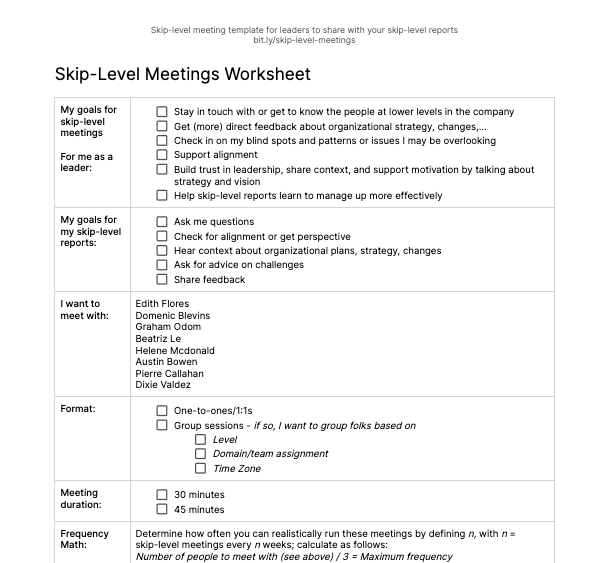
1. Define Goals, Attendees, And Format
Spend a little time thinking about what you want to get out of these meetings. After all, you and members of your team(s) are going to spend a significant time on those! Here’s what to think about and my recommendations:
Goals: What’s your goal for these meetings? Why are you offering them? - Refer to the notes above for inspiration.
Who do you want to meet with? - Make a list of names, so you can send them invites later on and know how many meetings you’ll need.
What format will be most useful to help you achieve your goals?
One-to-ones: Skip-level 1:1s are most common and can be helpful for candid conversations.
Group sessions: I’ve also made positive experiences with running skip-level meetings with groups of people with similar contexts, like the technical leads in a domain, or the senior engineering managers of a set of related teams. It’s a more unusual approach, but I find it very helpful in cases like:
The organization is so big that skip-level meetings would logistically only be doable once or twice a year
The rate of change is high, making it helpful to stay connected more closely
We’re hiring or going through an M&A or other situation where everyone’s calendars are very busy
I want to use these meetings as a way to encourage my skip-level reports (typically more senior engineers or managers) to shift in how they operate and manage up by asking them to explicitly think about organizational challenges
2. Determine Meeting Duration & Frequency
Duration: How long do you want your meetings to be? I’d recommend 25-30 minutes, up to 45 minutes if needed.
Frequency: How often do you want to run these meetings? You can always change this, I recommend:
Do the math: The meetings need to be (literally) manageable for you and everyone involved. Calculate how much is actually feasible; I recommend not more than 2-3 30-minute skip-level meetings per week for any manager, and would generally recommend erring on the lower side.
If you’re just getting started: Do only one round of skip-level meetings with everyone in your team(s), and communicate to everyone that that’s what you’re doing. After this first round of meetings, you’ll have a better sense of what’s useful and can decide if/how you want to proceed.
Typically, I found the following frequencies useful:
Monthly: In all cases where it’s useful to have more frequent touchpoints across the organization, e.g. for smaller teams/sets of teams, times of high change or scaling up, after big one-off changes like layoffs or re-orgs, or when a new manager joined your organization. I usually don’t recommend a higher frequency than monthly, that’s when the meetings tend to become too tactical and low-level and interfere with line managers’ work.
Every six weeks to quarterly: In larger organizations, or more stable teams
Occasionally, it can be wise to pause these meetings or set them to “on-demand only” (i.e., remove recurring meetings but let everyone know to reach out to you if they’d like to meet). This might be in times like e.g. when hiring is really intense and your (as well as everyone else’s) calendars are really packed
If your organization is very widely distributed, even globally remote, it can be worth doing more async check-ins instead.
3. Preparation Info
I always recommend to give your skip-level reports some direction for these meetings, to help you both make the most out of them and address some of the challenges of skip-level meetings beforehand. Here’s how I do this; you can download the full template with guidance and questions to adjust to your needs and share with your direct reports under this link:

A. I tell people what the meeting is for and about, as well as what I expect them to prepare for it
In the calendar invite (see next step), I include a note that conveys my goals and expectations for these meetings, something along the lines of:
I use skip-level meetings as a way to stay connected, understand what’s on your mind, what you need, and your perspective on how we’re doing as an organization - and provide context, perspective, and answers wherever I can.
I’d like for you to drive the agenda, so bring what matters to you, or use the suggestions below to spark ideas. If you don’t bring any topics, I will ask questions about areas that I’m curious about.
B. I share ideas of what they can bring or ask about to the meeting
I always share a document where I outline suggestions for things they may ask me about in these meetings. I found that a great way to let my skip-level reports know about the (many!) things that are okay to bring up, and spark ideas; it also serves as granting explicit permission to e.g. give feedback or ask about career development; especially as not everyone feels comfortable just asking for such things, it can be helpful to be upfront about that.
Some examples of my suggestions are below, they’re all written from the perspective of being read by your skip-level report:
Our vision, strategy, and goals
What aspects of our vision and strategy could you use more clarity or insight into?
Industry trends that you want to discuss or hear my take on
How your team contributes to the company’s goals
A recent project or goal that the department or your team have been working on
Your perspective on our organization
What am I overlooking?
If you were me, what topic(s) would you prioritize soon, and why?
What are our greatest assets/strengths, and our greatest weaknesses as an organization? What makes you think this way?
If you joined not too long ago, what’s exactly the way you expected it? What isn’t?
Appreciation
Whose contributions have been really impactful lately (for you, your team, or the company more broadly)? Who do you want to recognize?
Your professional growth & development
What would significantly improve your day-to-day work?
What growth path do you see for yourself in our company?
Your manager: What could your manager do differently to help you increase your impact? (Note: As mentioned in my article about challenges around skip-level dynamics, this question can be tricky, but is still worth asking!)
4. Send out calendar invites
You (the leader) send out and own the invite. That’s usually the most practical approach, as you likely have the more fully-booked calendar.
Bonus: Whenever you have skip-level meetings coming up, it can be worth checking in with the line manager: “I have skip-level meetings with $name soon, anything I should be aware of?” That’s a really simple, yet effective way to support your alignment.
5. Follow up and follow through
On any action items from your skip-level meetings: Close the loop! Follow up on action items from your meetings quickly and reliably. This not only reinforces your commitment to your skip-level and your interest in them, but also builds a culture of accountability.
By fostering alignment, uncovering blind spots, and building trust, skip-level meetings can be a really helpful tool in your leadership toolkit. Try them out, and let me know how it goes!