How to create accountability in your engineering organization
This article is the second of a three part series on the topic of accountability. Read part one: 7 signs accountability is low in your organization and part three: How to build a culture of accountability to support high-performing teams.
Article Overview/TL;DR
Instead of waiting for an incident to force the addressing of a lack of accountability in an organization, great leaders will intentionally build a culture of accountability. And this is not just about attribution and punishment.
Key takeaways:
Accountability is a willingness to accept responsibility for your actions - it’s about owning stuff, being accountable and holding others accountable too.
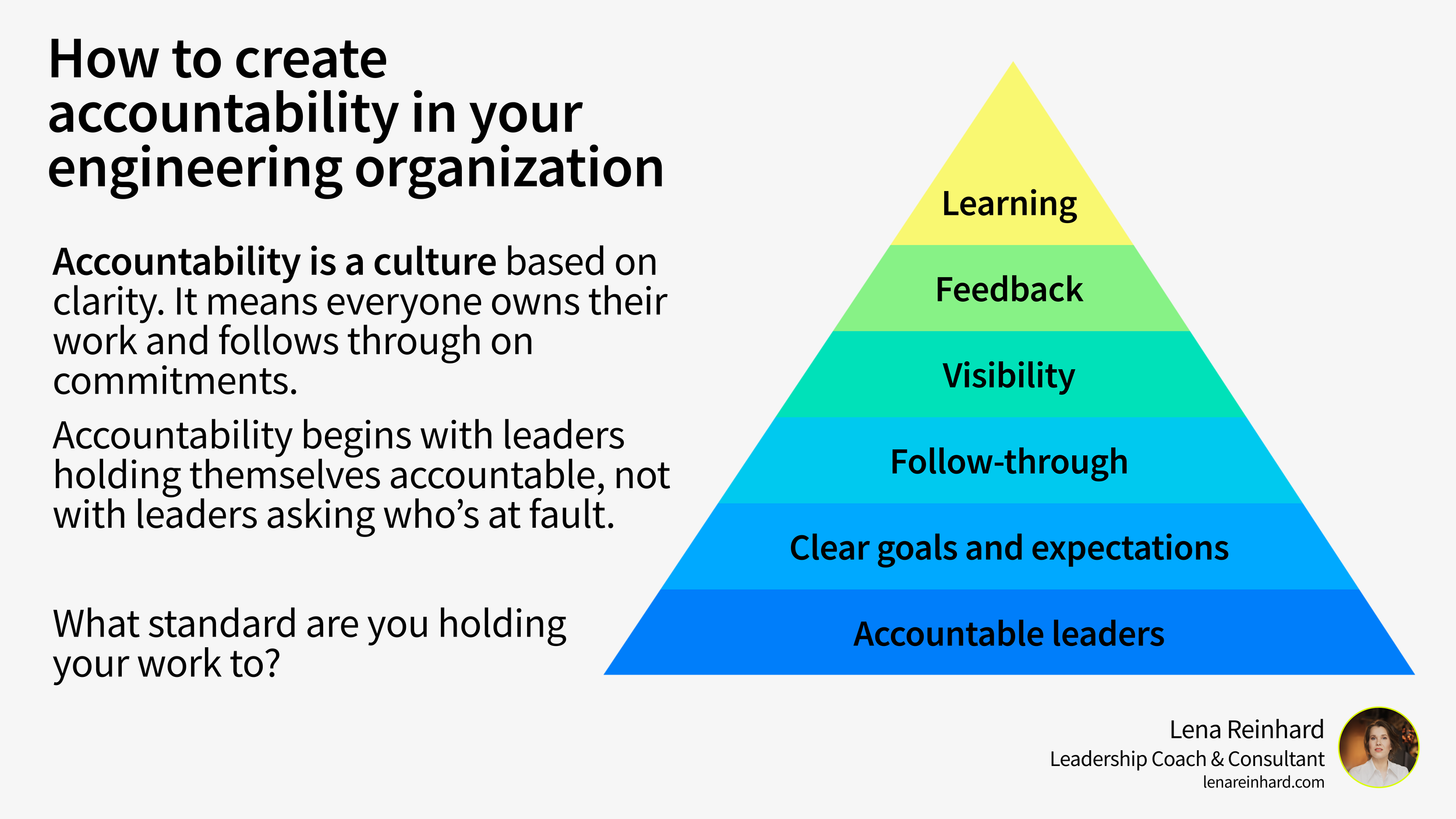
A high-accountability culture is built on: accountable leaders, clear goals and expectations, follow-through, visibility, feedback and learning.
Clear accountability fosters high-performing teams who feel more aligned with and connected to their work. It also increases employee engagement, promotes teamwork, and means better organizational results.
Accountability is a topic that most leaders try to ignore, until they can’t. They tend not to think about it when things are going well, but it always rears its head eventually. Often it takes a huge incident, a few quarters of teams missing goals, or pressure from investors, and some Executive will ask: “Who’s accountable?”
While we’re here, let’s get one thing out of the way: Accountability isn’t an ace up your sleeve / magic bullet / fix-all that you just pull out whenever it’s convenient for you. Because this approach is exactly what prevents real accountability.
I’m here to help you build a culture of high accountability in your team. In this second article of the series, we’ll talk about what accountability is in the context of engineering organizations, lay out how to get to get started with building a culture of accountability and cover how it benefits your teams.
What is accountability?
Most companies used to define accountability as (1) attribution: Who made the mistake?, and (2) punishment: What’s going to happen to them? I still sometimes hear leaders use it this way, but it’s more complex than that. As modern managers and leaders, we aim to build high-performing, autonomous, agile teams, and we’re invested in setting clear expectations, and fostering a blameless culture and psychological safety. We’ve run the incident reviews and gone over the five whys. We know that:
Organizational systems are complex. Failure is complex. There’s rarely a single root cause for any issue.
This also means that the old definition of accountability as attribution and punishment doesn’t work very well anymore. This is the point where many leaders get stuck: How do you instill accountability in this complex environment?
Accountability means “a willingness to accept responsibility for your actions”. It’s a critical aspect of performance management, because, more plainly, it’s about: Owning stuff, and owning up to it getting done.
Accountability has two components that are critical for leaders:
Being accountable: You take responsibility for your actions and lead by example. Being accountable yourself is the foundation for holding others accountable. People are good at spotting a hypocrite; if you don’t follow through on your own commitments, it’s going to demotivate your teams and decrease accountability.
Holding others accountable: You hold others responsible for their actions.
Accountability is a culture rooted in trust, built through:
Leading by example
Setting clear goals and expectations
Follow-through
Visibility
Feedback
Learning
This also means that accountability is not: A RACI chart, a roles and responsibilities document, micromanagement, or firing people with no warning. “Accountability” is also not a synonym for “punishment” or “layoffs”. And it’s definitely not a CEO writing in a layoff announcement “I take full accountability for the moves that got us here today”, laying off employees, while keeping their own job.
Six steps to building a high-accountability culture
Culture is the behavior that you reward and punish. The following steps will help you create a high-accountability culture:
1. Hold yourself accountable
This part is critical and most people miss it. Accountability needs to start with you as a leader: The standard you hold yourself to will send signals to your teams about what behavior is acceptable in your organization.
Do:
Take pride in your work and getting things done.
Follow through on what you committed to, and get back to the people you made those commitments to.
Manage expectations. You won’t always be able to get everything done. Let the people who count on you know before the deadline.
Own up to your mistakes. Admit what you did wrong, and how you will do better in the future.
Show that you’re learning. Actually commit to do better in the future.
Follow up on feedback that you receive.
Don’t:
Shy away from giving critical feedback or addressing issues because you’re concerned about how it will make you look.
2. Set clear goals and expectations that cascade through your organization
Setting goals and expectations serves three main purposes:
It makes sure that everyone in your company is moving in the same direction (alignment); that
they understand what’s expected of them (ownership); and that
work has the right size and shape to make progress, and make it visible (right-sizing).
Do:
Define clear goals for your company, departments, teams, and individuals. This means that goals should be:
Cascaded: Everyone can make the connection between their work and the company’s overall goals.
Set regularly: Quarterly is a good cadence for most.
Developed by the people who will be accountable for them: Let your teams know about the goals at the level above them (e.g. department or sub-department), and let them come up with ideas. The more involved people are in developing goals, the more ownership they’ll feel for getting them done. This also includes individual development goals: Ask your teammates to come up with proposals to discuss together, don’t be the person who writes them.
Measurable: Avoid binary (“launch x”) or unspecific (“understand y”) goals.
Owned: Every goal should have someone assigned to it who is accountable for its achievement.
Define roles and responsibilities. Everyone in your company should know what their role is, what they’re responsible for, and what success looks like for them.
Don’t:
Set conflicting goals, these will make it really hard to execute and make accountability murky. Very common issues are:
Product and Engineering set separate goals that both compete for teams’ capacity.
Sales teams make commitments to customers that conflict with existing priorities in implementation teams.
Individuals set goals that take away more time from their team level contributions than the team can afford, creating a conflict of interest.
Set too many goals. I often hear from companies that have “five focus areas” or “three top priorities”. I get it, there’s always a lot to do, and it’s tough to focus. If you don’t make a deliberate choice about what you want your teams to focus on, this choice will be made for you, and it’s not going to be one you like.
Create goals with dependencies between teams. This decreases the likelihood of work getting done, and makes it hard to instill ownership.
Believe that adopting OKRs will bring accountability into your company.
Assume that when people ask for a roles and responsibilities document, writing said document is all it takes to fix the issue. These documents can be useful, but when people explicitly ask for them, it’s usually due to bigger, underlying issues or even conflicts. This post has details on how to get to those.
3. Follow through on commitments
Doing what you said you’d do sounds simple, but isn’t always easy. Plans change, but make sure that it doesn’t become a habit, otherwise you’ll reach a point where people wonder why you even bother making commitments in the first place.
Do:
Practice what you preach: It’s easy to put values on your wall and forget what they mean. Some examples:
“We are committed to learning from incidents” also means that teams have space for follow-up work after incidents.
“We are invested in high-quality technology” also means investing in your tech, in service of a better experience for your customers.
“We are committed to diversity and inclusivity” also means that you need to take action when you notice that women and People of Color are systematically underpaid.
Don’t:
Regularly throw out goals. Startups and scaleups often need to pivot, and changing plans at short notice happens to all companies occasionally. But if you’re regularly throwing out goals, you may need to ask yourself if it’s worth setting goals in the first place, or how you’re formulating them. Goal setting is an incredibly expensive exercise; it’s usually worth it, but in order to realize the full benefits of this work, you actually need to get the results that you worked so hard to define.
4. Make progress visible
Do
Make progress visible to everyone. All goals and progress on them should be visible to everyone in your organization. (You may want to exclude individual goals from this, depending on how they’re set.)
Automate (some) visibility. Lots of goal-setting tools have built-in ways to give progress updates, but you can also use a simple spreadsheet.
Get regular progress updates from everyone who’s accountable. Accountability entails ownership, so this means that whoever owns it, needs to make its status visible. This template and approach work really well for this, it sets up a push system to get context to the right people.
Don’t
Make managers chase status information. Whoever is accountable needs to push information, not wait for managers to pull information from them.
5. Give feedback regularly and celebrate wins
Do
Everyone in your organization should get feedback about how they’re doing at least every two weeks. This includes praise as well as improvement areas.
Avoid surprises. There should be no surprise performance reviews.
Set team agreements about how peers give each other feedback. Many teams struggle with artificial harmony and not wanting to damage their peers’ reputation or progression, and tools like the lettuce pact can help set mutual expectations for being open with one another.
Don’t
Hesitate to address difficult issues. Letting a conflict simmer or a performance issue linger will usually only make it much worse, quickly. Have the tough conversations as early as possible.
6. Learn from failure
Do
Be open with mistakes that you or the company made. Talk about what they were, what you learned from it, and how you’ll do better next time. Oh, and do better next time.
Give teams space to learn from incidents and issues during incident reviews and retrospectives. Make space for them to work on action items from these discussions.
Review goal accomplishment and learn from what’s worked well (or not!), and build it into your next goal setting cycle.
Check if you did all the work before holding an individual accountable. There will be cases where an individual needs to be held accountable for their actions. In any of these cases, think about points like the following to check if you actually did the work to hold them accountable:
Expectations for their role were clear, realistic, and documented. You have consistent and reliable evidence that this person doesn’t meet these expectations.
There’s a pattern of repeated issues caused as a direct result of this person’s lack of skill or actions.
They received regular feedback about improvement needs within their control, were given an opportunity to improve, but there were no improvements.
You understand the factors that contributed to their behavior.
= Result: Clear accountability
The steps above will result in a culture where accountability is woven into the core of your organization and everyone’s actions.
Building a culture of accountability takes more time than skipping all these steps and just asking who will be punished for failures, and it’s worth it. It will foster high-performing teams who feel more aligned with and connected to their work. All of this also means increased employee engagement, better teamwork, and better results. Bonus: Fewer executives asking you “who’s accountable?”
Read the next article in the accountability series: an interview with Jasmine Jackson-Irwin on her experiences of building cultures of accountability.