Managing Up: Debugging the most critical relationship in your work life & Working Better with an imperfect boss
This article is a snapshot of my talk from LDX3 London 2025.
This condensed version of my talk focuses on quick-start actions.
If you want to dive deeper into managing and developing a good working relationship with your boss, check out my Managing Up series of articles: https://www.lenareinhard.com/articles/managing-up
View and download the presentation slides (pdf format) here.
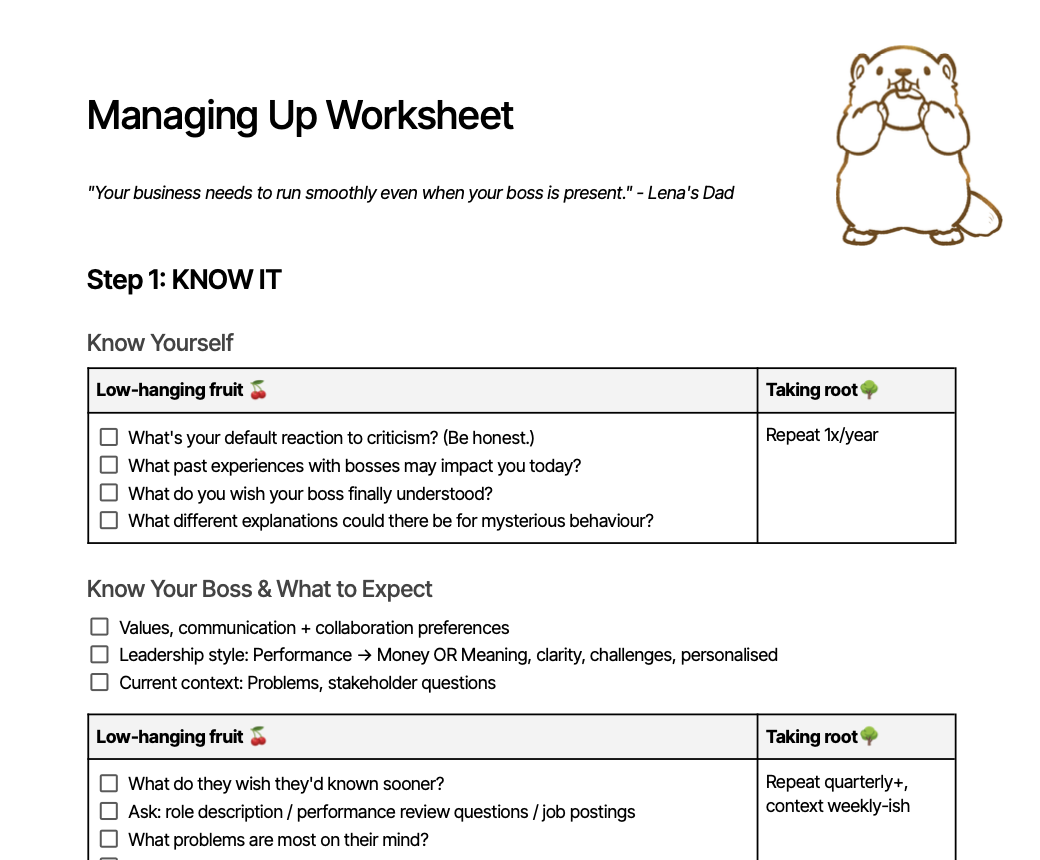
Download the Worksheet to Manage your Boss
Protecting your garden
To set the scene, imagine this scenario:
You’ve planted a thriving garden in your backyard. It took a lot of time, and you put lots of love and care into this garden. You’ve got it all: Blueberries, strawberries, tomatoes, peppers, carrots. All the best garden snacks.
One day you realise that your strawberries are gone. And your carrots have bite marks that look definitely non-human. So, you put up a camera and learn that your garden is being visited by a groundhog.

What now?
You put a fence! But the groundhog digs underneath and finds other ways inside. Even worse, the groundhog starts eating your produce right in front of the camera. It’s like the little guy is laughing at you.
So, that’s not working. What next? The groundhog is disturbing the peace and beauty of your garden. This really sucks, and you feel kinda powerless.
That feeling of frustration with the groundhog - That’s how many people feel about their managers.
Dealing with the groundhog
Ultimately, I want you to have better tools to work with. You’ll need good tools to navigate working with an imperfect boss and to learn how to handle the feelings of frustration that come up in the process.
I also want to inspire confidence within you to try things out, so you can learn to work better with the not-quite-perfect boss you have.
So, how to handle this groundhog?
Obviously, we don’t kill the groundhog. We don’t get rid of the groundhog.
The best way to deal with this groundhog is to get to know it, what it’s dealing with, what it likes, how it operates, etc. Then, you plant an additional garden patch full of the things they like and grow along with your existing garden.
And then you show it. You make sure these groundhogs see the food you’ve grown for them! Make it a habit, because groundhogs go into hibernation for months.
But, thankfully, your boss prob doesn’t hibernate for months.
Before we get into the meat of this talk - a worksheet! on how to manage your boss. Feel free to make a copy and use it to implement things you’ve learned in today’s talk.
Next up: How to deal with bosses - and groundhogs.
Signs to manage your boss more
You have a boss
You have problems with your boss
A lot is changing
You’re here now
Most of us aren’t born with this skill. However, managing your boss is a skill that can be learned. And it’s an important skill for everyone, no matter experience level and regardless of whether you have direct reports.
Successful boss <> employee relationships
You want to have a bar you can measure against how your work with your boss is going. What does your current relationship look like versus a successful one?
The relationship should work for both of you while also helping the business achieve its goals. When building a successful relationship, we’re aiming to:
Deliver results, done well, through productive collaboration.
Efficient, productive partnerships don’t waste each other’s time). Ideally, there is neither micromanagement nor under-management. This is the spectrum of “manager does everything themselves + knows everything better” vs. “no goals, no accountability, no feedback, no interest”.
Not adversarial but also not a friendship.
Have an appropriate boss <> you-level involvement level.
This can vary.
Boss may be hands-off, but may want to be deeply involved in a critical project
Be aligned, accountable, autonomous - balanced. With a shared understanding of goals, success.
Be trusting and respectful. Motivational.
Again, there’s a strong mutual respect. Plus listening, feedback, and learning.
This relationship will and should change over time as the org, you, your boss, or circumstances change.
🍓 Low-hanging fruit: Ask them →
What do they wish they’d known sooner?
How can you support them better?
🌳 Taking root
Repeat quarterly.
Boss <> you: It’s complicated
In reality, we all know it’s not that easy to have a successful working relationship with your boss. Like the iceberg model, some things are visible. Then, there’s much more below the surface.
A variety of different factors impact your relationship with your boss. For example, tacit knowledge, (i.e. the unknown knowns / things you don’t know that you know), are one of the greatest sources of issues. This type of knowledge is most often underestimated and overlooked as a reason for misunderstandings and conflicts.
And, that’s only the start of it. Your relationship with your boss is also impacted by:
Communication & language: For example, how well you both speak and write your shared language, and how you read and interpret written language (yes, that includes emojis, too). Then, consider that you each have your own thoughts, feelings, body language, communication skills, and a differing ability to express needs & expectations.
Personalities: Points of view, opinions, goals, working styles, communication preferences + styles, role + level, incentives, relationship to risk & uncertainty, attitudes, health, wellbeing, stressors, triggers, personal relationships.
Work & life experiences: Biases, values, upbringing, cultural + social + educational background, relationship to authority + power, class.
Company context: Industry, market, competition, goals, stage, shape; organisational shape, financial situation.
Broader context: Global + local economic situation, social + political environment & climate, supply chains, labor market
How to manage your boss
Step 1: Know yourself, your boss, and your work
Know yourself, so you can manage yourself
Like with pretty much everything in leadership, you need a foundation of solid understanding.
Knowing yourself includes figuring your your values, needs, and how you handle criticism, and which tendencies you have that don’t serve you anymore (like people pleasing, challenges with boundaries).
Knowing your work and your boss includes knowing your work culture, your view of past bosses and work experiences.
An example of when knowing your boss makes a difference:
A former client of mine, Chris, felt his new boss didn’t trust him. He had similar issues with previous managers who would question everything that he did and often overrode his decisions. Chris would often get stressed with his new boss. After getting to know himself, his boss, and his work better, it turned out the new boss was just genuinely trying to understand and be supportive.
It’s also important to consider your boss and what their own doubts are about their work. What stressors or annoyances are they dealing with?
🍓 Low-hanging fruit
What’s your default reaction to criticism? (Be honest.)
What past experiences with bosses may impact you today?
What do you wish your boss finally understood?
What different explanations could there be for $mysterious_behaviour?
🌳 Taking root
Repeat 1x year.
Know your boss & what to expect of them
This is where we find out what the boss/groundhog we’re dealing with likes, so we can then plant these things in the garden.
We need to find the answer to:
What are your boss’s values, communication, and collaboration needs?
What can you expect of them?
You may find the answer by either asking your boss directly, reading your boss’s role description, or reading your company’s performance review questions.
🍓 Low-hanging fruit
What do they wish they’d known sooner?
Ask / role description / performance review questions / job postings
What problems are most on their mind?
What questions do they get from our stakeholders?
🌳 Taking root
Repeat quarterly + context weekly-ish
What makes a good boss for you may not be the same as what makes a good boss for the business.
Ideally, it should be both, but it doesn’t always work that way.
An example: Anna, a newer director in a new-to-her business area, needed a lot of support from her boss. But her boss had to spend most of their time on strategic work that was critical for the business.
The best you can do, which is what Anna did, in a situation like this is to talk openly about it with your boss and see what alternatives exist, (e.g. mentoring from someone else).
The work: What’s expected of you
Many people are bad at expressing expectations, including bosses. Sometimes expectations are too abstract, other times they’re too granular.
For example, “Work independently”. This is a phrase I’ve seen mean anything on the spectrum of “Just make sure stuff gets done and don’t bother me, I just want to know when it’s finished” <> “But verify any action with me first”. Do you see why clarity is so important?
When finding that clarity, you may have to go through multiple sources to narrow this down. Your role description is a starting place but may not be super useful.
If you’ve been to one of my talks, you may remember the idea of the German idiom of the “egg-laying woll milk sow”, “eierlegende wollmilchsau” (happy to help you learn to pronounce it).
It’s the perfect hybrid livestock that does everything, fulfills all needs, and doesn’t exist.
Helpful lenses to add:
Systems theory: Your function: Common functions for senior+: Filling gaps, triaging + prioritising work, keeping a team/domain afloat. What are you really here for? Get to that: What would fall apart if you weren’t here?
Goals, including your goals and your team(s) goals.
Feedback - perf review
🍓 Low-hanging fruit
What are you really here for?
🌳 Taking root
Repeat quarterly
Step 2: Grow it
Apply what you’ve learned in how you work + get support along the way.
Own your work
There’s always a risk in putting yourself out there. You’ll only know what your groundhog likes if you give them some vegetables to chew on.
Deliver reliably, fast, good-quality work, in time, without having to be prompted, supervised, or monitored. You already do that, so we can move on to the second part of this.
Owning your work involves saying no sometimes. Great leaders aren’t great because they get everything done, but because they choose what they do not do.
🍓 Low-Hanging Fruit
Keep a running list of what you’re saying no to, makes it visible + helps you see over time if you’re making good decisions about what to prioritise.
Get support to grow
Two things that a LOT of leaders are neglecting are:
Using skip-level-meetings. With your boss’s boss: ask them what’s on their mind, questions they get, or even advice/recs for how to work with your boss. Ask for them if they’re not offered to you.
Working with your peers closely. COMPLETELY AND DANGEROUSLY UNDERUTILISED. Everyone is so busy and focused on their own problems that they don’t realise how much potential they’re letting slip away by not working together. This may come as a surprise, but many peers have very similar issues
🍓 Low-Hanging Fruit
Talk to your boss at least every few weeks. Talk about, yes, how to work with your boss, help each other out, share what’s going on in your teams.
🍓 Low-Hanging Fruit (Bonus!)
Template message your peers.
“I saw this super good talk at LDX3 about how to manage up.
Speaker: ‘Important to work together as peers!’
Let’s try for 3 months? [link talk].”
🌳 Taking root
Repeat monthly
Step 3: Show it
You’ve heard the phrase “show don’t tell?” Well, many of us were raised on the idea that “good work will speak for itself”.
It. Will. Not. Your boss won’t know what you did unless you tell them
Show that you’re doing the work + connect it with what you know + validate it. Show your groundhog where you planted the stuff they like!
If your boss doesn’t “get it”, chances are you may need to tell them.
Reporting is boring? True, but it is essential.
I’ve worked on this with *so many* leaders. From tech leads, EMs, to VPs and C-level. This feeling of “my boss doesn’t get what I’m doing” is one of the primary sources of frustration between leaders and their bosses.
If you feel like your boss isn’t “getting what you’re doing”, “doesn’t understand what your team is dealing with”, this ☝️ is a very good place to start. Because there’s a chance that at least part of the reason is that you’re not telling them the information they need, when they need it.
Another benefit to reporting - You create a written record of what’s going on and a record of what you have done.
Show the work & ground it
Show your work to align goals – People – Your next priorities.
!! This is information that isn’t already in your project mgmt tool !!
Make it land by grounding it in what you know.
Talk about the impact of the work (“X led to y”). Connect with what they care about (--> their values, problems).
I’m not a fan of the “Don’t bring problems, bring solutions” saying often used to mean “don’t tell me anything that’s not going well”. Instead, bring problems & options (“Z problem, options 1, 2 to handle it; I’d do 2 because, what do you think?”)
Do this weekly, start with sending this via email. When you’ve asked your boss how they like to receive that kind of info, you can still move to a shared document, chat, (or voice memo if you’re a young person 😃).
🍓 Low-Hanging Fruit
Do this weekly in writing
Bonus: Ask your reports to do this for you
🌳 Taking root
Weekly
From show it to know it
We’ve come full circle now, from show it to know it. It’s time to validate and see if there’s something new to know.
Ask for feedback.
“Advice/feedback for me (about $specific)?
The more senior you are, the more your “feedback” will just be [your continued employment] / “you still work here, so you must be doing something it can’t be that bad.”
Take feedback with curiosity and follow up.
The best answer, at first, is always “Thanks, I’ll think about it.” If you feel yourself getting defensive, get curious - prompt them with “tell me more”.
Own to understand.
Take ownership of understanding what they tell you. Techniques to confirm understanding like simple playback can go a long way: “To recap what I heard,...”
A quick recap
Step 1: Know it
Know yourself, your boss, what you can expect from them, what they can expect from you, and how your work together is going.
Step 2: Grow
Do your work reliably, say no more, get support along the way from peers, and connect with your boss’s boss.
Step 3: Show
Weekly, talk about impact and connect to what your boss cares about. Ask for feedback to connect to knowing. Validate and adjust along the way.
If you feel stuck in the same thing happening over and over again, give your groundhog something new to chew on.
And always remember:
“Your business needs to run smoothly even when your boss is present.”